Acrocanthosaurus: The T-Rex of Texas and Its Prehistoric Hunt
email: noellemoser@charter.net

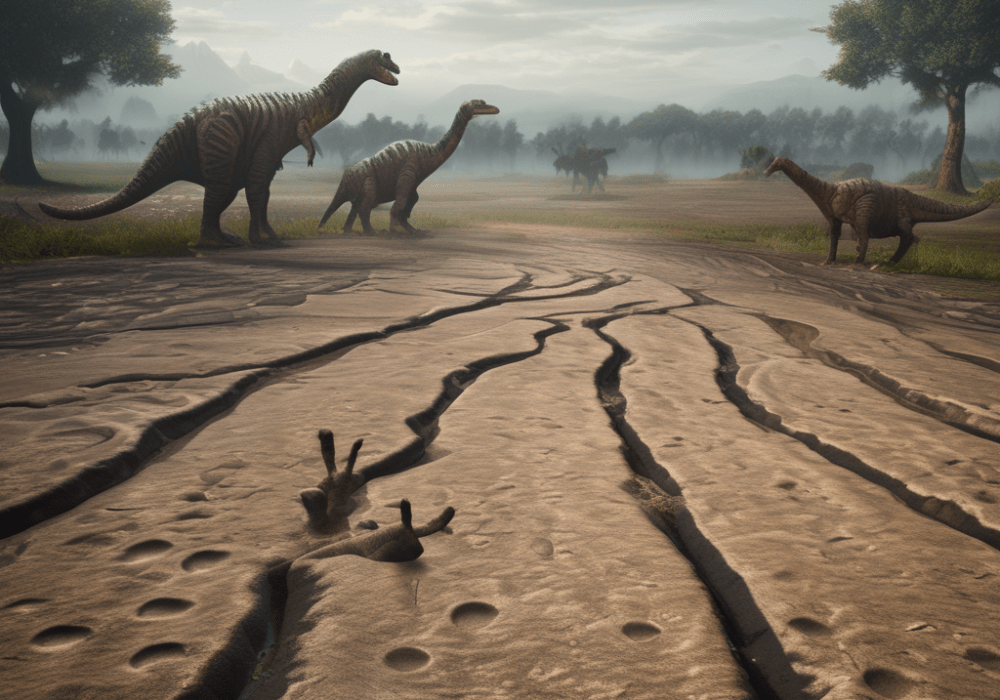
120 million years ago, along a muddy cretaceous flood plain, the relationship between dinosaurs was laid out in stone. A herd of massive sauropods slowly trudged alongside a waterway stocking, and following closely behind was a large carnivore. The trailing theropod had an objective; the carnivore was on a hunt.
Following behind the herd, slightly to the left, the theropod’s tracks indicate that the hunter rhythmically trailed the lumbering sauropods. Then the theropod’s footprints show that the hunter suddenly skipped a few steps, meaning only one thing, an attack.
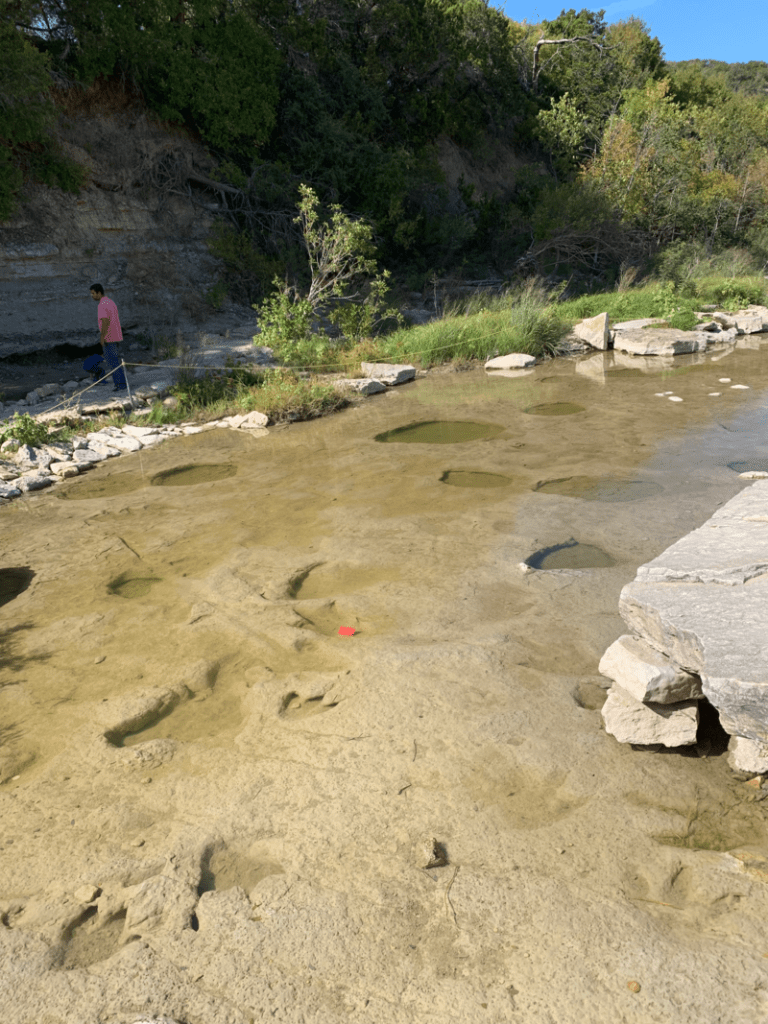
Laid out in the sediment along a muddly flood plain. It is along the Paluxy River near Glen Rose, Texas, USA. There is an epic tale of a dinosaur hunt. It is recorded in stone. The footprints only tell part of the story. It is unclear if the theropod’s efforts were successful. What we do know is that Acrocanthosaurus (AK-ro- CANTH-oh-SORE-us) Atokensis was the hunter. Sauroposeidon (SORE-oh-puh-SY-don) Protheles were the prey.
First discovered in the 20th century, a complete examination of the prints was conducted in 1935 by Roland T. Bird. Bird was the first to recognize the tracks as a “chase sequence” between the herbivore herd and the theropod. Exhaustive studies by many paleontologists and recent computer analysis concur with Bird; the tracks are a prehistoric early cretaceous hunt.
Acrocanthosaurus Atokensis: The T-Rex of Texas

To fully appreciate the “chase sequence” discovered by Roland T. Bird, we need to understand the participants in this epic early cretaceous tale. Known as the T-Rex of Texas, Acrocanthosaurus is one of the largest Cretaceous theropods known to exist. It is second only to Giganotosaurus, Carcharodontosaurus, and Tyrannosaurus Rex, respectively.

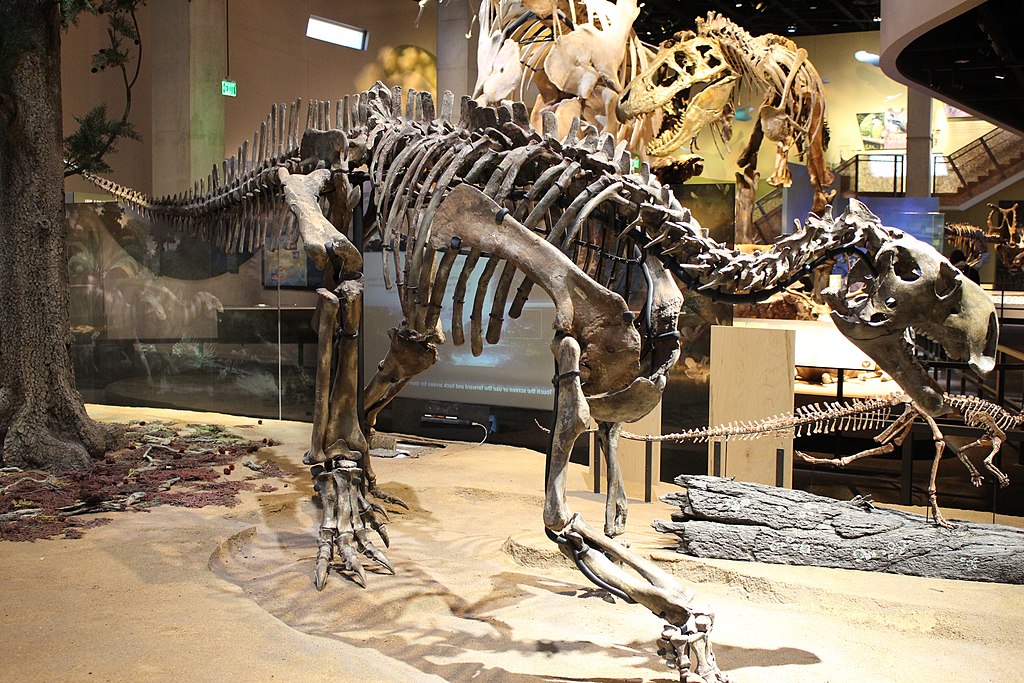
Acrocanthosaurus meaning “high-spined lizard,” is a genus of carchondontosaurid. It is known for high neural spines on the vertebrae. It is one of the most spectacular hunters of the Cretaceous. Acrocanthosaurus has jaws packed with 68 serrated teeth. It has a body length of 36 to 38 feet. It weighs 4-6 metric tons. It is native to North America. Fossil remains are only found in Oklahoma, Texas, and Wyoming. A few teeth found as far away as Maryland suggest a continent-wide presence.
Despite its gigantic size, an examination of the skeleton shows that the thigh bone is longer than its lower leg bones. This means that Acrocanthosaurus was not a fast runner. Outpaced by many of the swifter hadrosaurs like tentosaurus and other herbivores, Acrocanthosaurus would target massive slower-moving prey. Such prey included Sauroposeidon. This is evidenced by the Peluxy River trackway.
Unable to run down its prey, Acrocanthosaurus relied on pack cooperation with a slice-and-dice approach to hunting. Outweighed by the immense size of the Sauropods, it would be foolish for Acrocanthosaurus to attack the lumbering sauropods. Rather than risk injury, the theropods would take turns biting and slashing. Their objective was to keep the prey moving and bleeding. Weakened through blood loss, exhaustion, and infections inflicted by Acrocanthosaurus, the Sauroposeidon would eventually collapse under its weight. It would feed the local ecosystem, including Acrocanthosaurus, for days.

Like other Cretaceous theropods, Acrocathosaurus had a large complex brain. In 2005, scientists created an endocast of the braincase of Acrocanthosaurus. They found that while the brain is similar to many theropods, it is most similar to that of allosauroids. Specifically, it is similar to Carcharodontosaurus and Giganotosaurus. This provides further support for the hypothesis that Acrocanthosaurus was indeed a carcharodontosaurid.
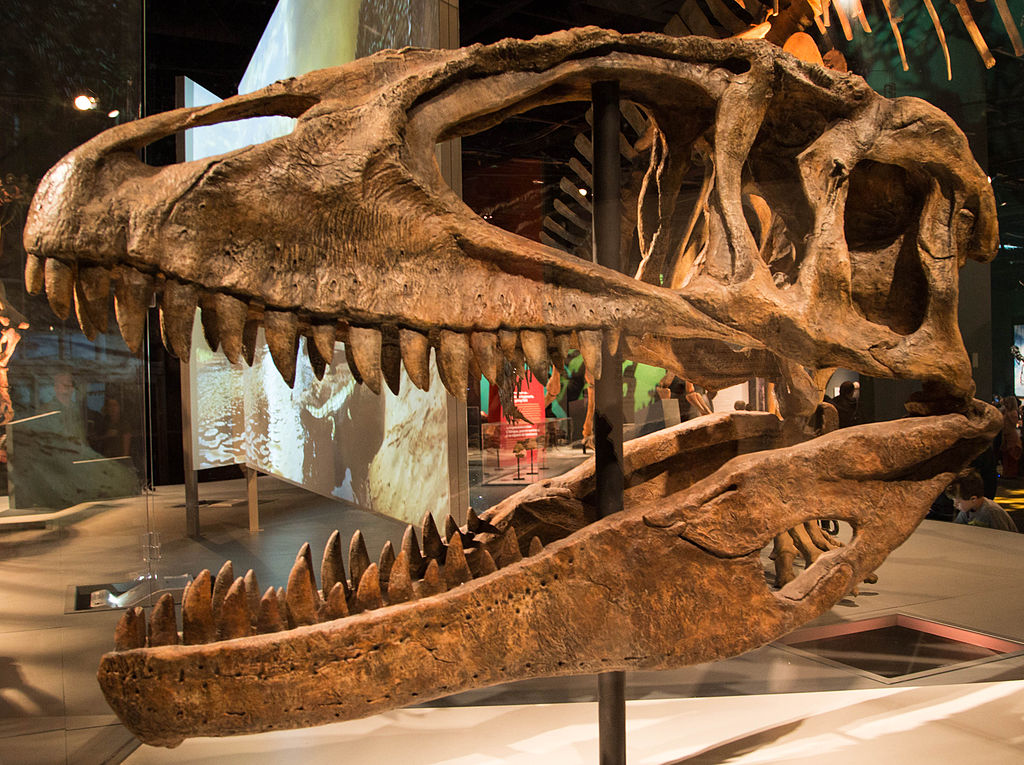
Like carchodontosaurus, Acrocanthosaurus had an enhanced optic nerve. This indicates that these theropods had stereoscopic binocular vision. Therefore, they could accurately discern depth and distance. A large auditory bulb supports impeccable hearing capabilities. Overall brain size suggests advanced intelligence. This includes planning and social interaction behaviors.
Sauroposeidon: “The Earth Shaker”
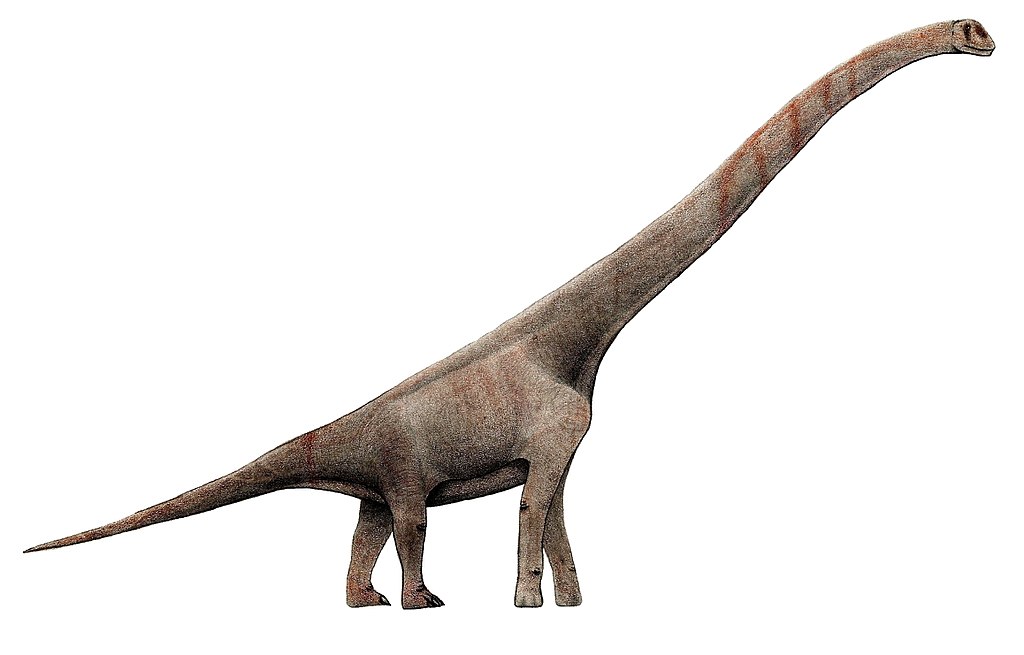
Every ecosystem must sustain a never-ending balancing act to survive, a delicate relationship between predator and prey. Where there are large carnivores, large herbivores are needed to preserve this balance. While they may seem defenseless, titanosaurs like Saurposeidon were well-defended and not easy meals to obtain by local predators.
Named after Poseidon, the Greek god of the sea and the god of earthquakes. Sauroposeidon made the ground tremble. It literally shook the earth as it walked. These titanosaurs were one of the largest animals the planet has ever seen. They were outclassed only by Argentinosaurus. Argentinosaurus was only slightly longer and heavier.
Titanosaurs lived by one rule, get big and get big fast. From the moment of hatching, sauropods like Saurposiedon were eating machines. Dining on leaves and hard fibrous vegetation, a herd of titanosaurs could defoliate an area in a few days. Large guts and hard-to-digest food allowed for a slow release of energy over time. This superpower aided in the ability of these sauropods to reach full size in less than ten years. Once fully grown, an adult Sauroposiedon was 100 ft long, 65 ft tall, and weighed 60 to 66 tons. This sheer size alone was enough to detour many theropods from making a meal out of these massive herbivores. Traveling in herds combined with size officially removed them from the menu.

Hunting a herd of Sauroposeidon was very dangerous. One wrong move and one of these massive herbivores could easily crush, instantly killing an over-eager theropod. Given this danger, the question becomes not did Acrcanthosaurus hunt one of the titanosaurs but how.
Like many questions left by extinct creatures, the best way to answer these questions is to look at the present. When we observe lions hunting a herd of wilder beasts, the predators will work together to break up the herd. They single out the small, sick, or weakest members. This makes for an easy kill. A lion knows that attacking the largest, strongest, or healthiest individual would be a dangerous mission at best. We can apply this same reasoning to Acrocanthosaurus.
Traveling herds are very organized. Babies and subadults are in the middle. The large and healthy adults assemble around them as hedges of protection. Elderly or injured individuals typically follow behind the main herd forming the rear as the herd marches across the land.
The hunting Acrocanthosaurus is stalking the herd from behind slightly to the left. It is clear that the predator is aware of this herd dynamic. This Sauroposeidon is not in the prime of its life. It is still a dangerous animal and can inflict injury or death on the theropod. It is most likely for this reason that the Acrocanthosaurus rhythmically steps with the herd. When the time is right, it lunges toward the individual and makes a calculated attack.
The soft mud of the Texas floodplain records this dance between predator and prey several times. Then the tracks disappear, lost in time. This leaves the end of this Cretaceous tale a mystery for paleontologists to solve 120 million years later.
It is unclear if Acrocanthosaurus ate dinner that day 120 million years ago. However, the titanosaur eventually succumbed to the injuries. It provided enough meat to feed an ecosystem for days.
Most of the trackway was removed. It is now preserved and displayed at The American Museum of Natural History in New York. Some of the trackway still remains submerged under the Paluxy River near Glen Rose, Texas.
Many people visit this site every year and behold the immense size of the footprints left in the mud. What they may fail to realize is the importance of these tracks. This trackway is more than impressive prints from creatures of the past. These prints show the interaction and relationship between two kinds of dinosaurs, predator and prey. They roamed Texas millions of years ago. Their interactions are recorded in stone.


I write at the confluence of deep time and modern thought – a paleontology blogger and essayist devoted to translating ancient worlds for contemporary readers.
Through Coffee and Coelophysis, I explore the lives, mysteries, and afterlives of prehistoric dinosaurs, blending scientific curiosity with reflective story telling. I bring ancient fossils to life; across my other writing spaces, I explore literature, creative reflection, homesteading, backyard chicken keeping, and the lessons of observations.
In Shelf-Life: Lessons from Retail, the everyday world of retail becomes a stage where dinosaurs, books, and human stories collide – revealing how curiosity and wonder shape both past and present.
 Coffee And Coelophysis


