Finding Depth in Dinosaurs: A Journey from Adornment to Archives

Image Credit: OpenAI Image Creator: Tyrannosaurus Rex adorned walking into a store of tomes.

It has been some time since I last wrote within the fossil-rich corridors of Coffee and Coelophysis. Not because the passion diminished, or because the fascination with deep time, theropods, or the osteological poetry of extinct giants ever receded. But because the conditions required for this kind of writing became buried beneath the sediment of vocational life. Paleontological writing, I have come to realize requires a particular mental climate. It requires stillness, cognitive oxygen, and uninterrupted corridors of thought. And for a time, I found myself inhabiting a very different ecosystem.

The Biome of Adornment:

Image Credit: OpenAI Image Creator. Tyrannosaurus Rex misplaced among accessories.

My previous professional habitat was one of adornment – a landscape structured around ornamentation, self-presentation, and the anthropology of display. It was an environment of rhinestones, polished metals, seasonal palettes and rotating aesthetics. On the surface, it may seem far removed from paleontology, and yet, even there, my mind refused to fully migrate. Because adornment, when examined through an evolutionary lens, is not foreign to prehistoric thought.

Display structures dominate the fossil record of behavior. The crest of Allosaurus, horns of Triceratops, feathers of Archeopteryx, and the coloration of today’s dinosaurs – birds.

I often found myself thinking – sometimes idly, sometimes analytically about the continuity between human ornamentation and Mesozoic display behavior. Earrings became analogues to integumentary signaling, hair accessories echoed plumage, and jewelry functioned as modern exaltations of ancient display instinct.

Even in a biome dominated by surface aesthetics, my thoughts drifted persistently toward bone, integument, and evolutionary signaling. The paleontologist never left, she simply observed quietly. Told through the ancient wisdom of dinosaurs, field notes from my time in accessory retail are chronicled in a blog entitled Shelf-Life: Lesson from Retail.

Writing in Fossil Suspension:

BHI 3033 (Stan) and I standing at the intersection of popular culture and science.

Despite that continuity, something within me entered a state best described as fossil suspension. My writing did not go extinct, it fossilized. Buried beneath the comprehensive weight of retail space, social performance, and cognitive fragmentation, the deeper analytical voice that fuels this blog entered preservation mode-intact, but inaccessible.

Fossilization, after all, is not destructive. It is deferred revelation. And like any specimen awaiting excavation, the writing remained, waiting for the right sedimentary pressure to lift.

Following the Fossil Trail:

Image Credit: OpenAI Image Creator: Tyrannosaurus Rex amongst tomes.

When the shift finally came, it did not feel like escape, it was track following. Paleontologists know the intimacy of trackways, the act of tracing fossilized footprints across lithified ground, step by step, reconstructing the movement of a lifeform long vanished. My vocational transformation felt much the same. I did not abandon one ecosystem so much as follow a fossil trail toward another.

Each step marked by subtle signals, a resurgent desire to think and read more deeply, growing hunger to write, mental fatigue from surface engagement, and a longing for intellectual stratification. Instinct-that ancient navigational system shared by migratory species-took hold. And it led me, trackway by trackway, toward archives and tomes.

Entering the Archive Biome:

Image Credit: OpenAI Image Creator: Tyrannosaurus Rex browsing shelves of tomes

I now work within tome retail. An environment that, while not a museum or dig site, operates within the same preservation philosophy. Where adornment retail curated surface, archive retail curates memory. Where one displayed object of identity, the other houses narratives of existence.

Stories like fossils, are preservation technologies, they hold life in suspension across time. I no longer pierce adornments into bodies; I place stories in hands. In doing so, I find myself participating once again in the work of temporal preservation-the safeguarding of knowledge, wonder, and deep time literacy.

Vocational Proximity to Dinosaurs:

Image Credit: OpenAI Image Creator: Tyrannosaurus Rex reading books in a library.

It would be easy to assume that because I am not currently in a museum lab, a prep room, or a field excavation, I exist at a distance from paleontology. But distance from dinosaurs is not measured in miles from fossil beds, it’s measured in cognitive proximity to the conditions that allow them to live in the mind.

Tomes reduce that distance, rather they restore by increasing reading stamina, research access, writing energy, and intellectual curiosity. They create an atmosphere where prehistoric life can breathe again, not in bone, but in thought.

Dinosaurs, for me, have always functioned as a vocational compass – a fixed point in deep time against which I measure the alignment of my life.

When I drift too far into environments that prioritize velocity over reflection, trend over truth, and surface over structure, I feel their absence like oxygen deprivation. But place me among books, archives, histories, preserved narratives and they return immediately, not as relics but as guides.

Preservation, Not Destination:

Image Credit: OpenAI Image Creator: Tyrannosaurus Rex skeleton guarding the knowledge and narratives frozen in time.

This migration into tomes and archives is not an endpoint. It is a supportive biome, one that funds, nourishes, and stabilized the intellectual life required to pursue paleontology with depth and integrity.

The fossil trail does not end with tomes, it passes through on its way back to research, writing, museums, and field sites. To wherever the next excavation of self and prehistory awaits.

In the meantime, I remain in vocational orbit around the creatures who have always oriented my internal compass, reading, writing, and still chasing dinosaurs.

Image Credit: Noelle K. Moser. Sue, Tyrannosaurus Rex skull. The Field Museum. Chicago, IL.

I want to close this reflection not in dismissal of the ecosystem that came before, but in gratitude for it. Adornment retail was not a detour from my path, it was a formative stratum within it. It taught me to observe human behavior, to lead, to communicate, to endure high-velocity environments, and to recognize the anthropology of display in ways I might never have studied otherwise. Even there, among headbands and scrunchies, the paleontologist in me remained awake, watching, interpreting, and learning.

For that, I am thankful. But gratitude and belonging are not always the same thing. Because if the former biome was one I learned to survive within, the new one is where I instinctively breathe.

Within the archive corridors of tomes among shelves that function like stratigraphic layers and stories that preserve life across time, I feel a cognitive and creative homecoming that is difficult to articulate but impossible to ignore.

I do not feel displaced here, I feel situated, and aligned. As though I have stepped into an environment where the deeper architecture of who I am as a reader, writer, and paleontological thinker is not merely accommodated, but oxygenated.

Adornment taught me much, archives restore me. And from this restored ground, the fossil trail continues forward, deeper into writing, research, and ever closer to the ancient creatures who have always oriented my vocational compass – Dinosaurs.

Stan and I. Houston Museum of Natural History. Houston, TX

I write at the confluence of deep time and modern thought – a paleontology blogger and essayist devoted to translating ancient worlds for contemporary readers.

Through Coffee and Coelophysis, I explore the lives, mysteries, and afterlives of prehistoric dinosaurs, blending scientific curiosity with reflective story telling. I bring ancient fossils to life; across my other writing spaces, I explore literature, creative reflection, homesteading, backyard chicken keeping, and the lessons of observations.

In Shelf-Life: Lessons from Retail, the everyday world of retail becomes a stage where dinosaurs, books, and human stories collide – revealing how curiosity and wonder shape both past and present.

Sue Tyrannosaurus Rex: Life, Pathologies, and Controversy

email: noellemoser@charter.net

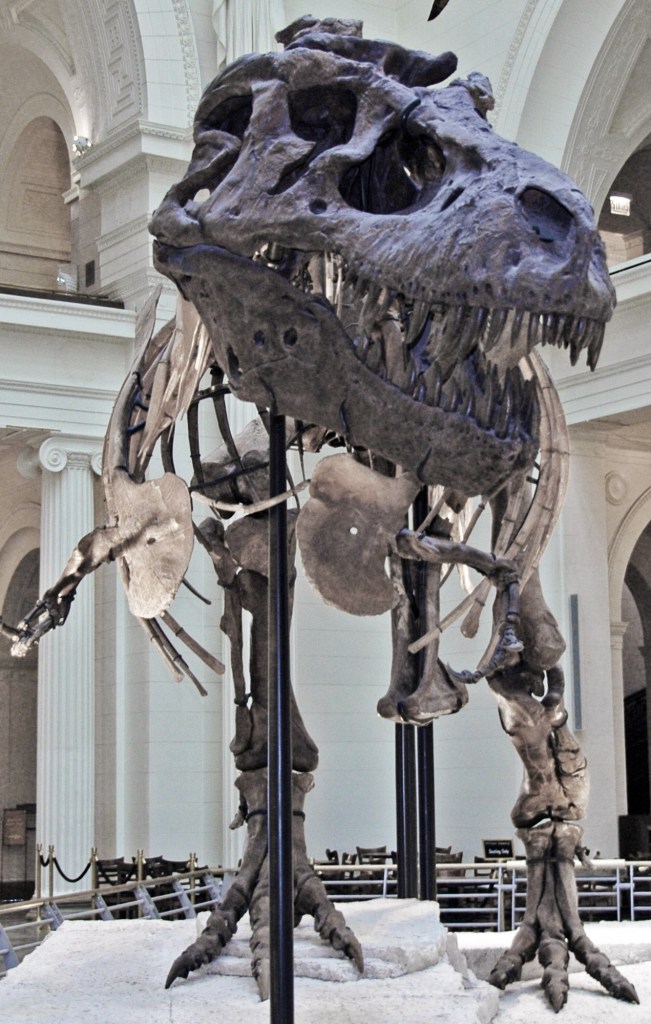
Image Credit: Sue Tyrannosaurus Rex (FMNH PR2081). Field Museum. Chicago, Illinois.

Everything about the Tyrannosaurus Rex overwhelms the human imagination. 50-60 bone-crushing teeth, a massive eight-ton weight, and formidable strength. Nothing can stop this terrestrial meat-eating machine, or so we think. Sue, the largest, most extensive, and best-preserved Tyrannosaurus Rex ever found, tells a different story. Sue had a hard life. Her remarkable skeleton tells of battle, disease, starvation, and the life lived by an old T-rex.

Discovery of Sue:

Image Credit: Noelle K. Moser. Sue-Tyrannosaurs Rex-close-up of the skull showing conical bone-crushing teeth used to kill and crush the bones of her prey. Field Museum. Chicago, Illinois.

Sue’s story began in 1990. Scientists spotted bones protruding from a cliff face in South Dakota. These bones belonged to an adult Tyrannosaurus Rex. Scientists determined that 90% of the skeleton was present. This made the specimen (FMNH PR 2081) the most intact T-rex ever discovered. Named Sue, this tryannosaur became the subject of a heated dispute over legal ownership. Sue’s final resting place was on land the Sioux Tribe claimed belonged to them. However, Sue’s bones were on land that was held in trust by the United States Department of the Interior.

In 1992, Sue’s bones were seized by the FBI. The government transferred the remains to the South Dakota School of Mines and Technology. The skeleton was stored until the penal and civil legal disputes were settled. In October 1997, several large corporations and individual donors purchased Sue for 7.6 million dollars and transferred her to her new resting place at the Field Museum in Chicago, Illinois.

Image Credit: AI-generated. Sue’s skeleton is 90% complete making her the most intact Tyrannosaurus Rex ever discovered.

Life of Sue and Pathologies visible in her bones:

Examination of the bones determined that Sue died at 28 years of age, one of the oldest Tyrannosaurus Rex known. During her life, Sue suffered many pathologies, including broken bones, torn tendons, broken ribs, bone infections, protozoan parasites, and arthritis.

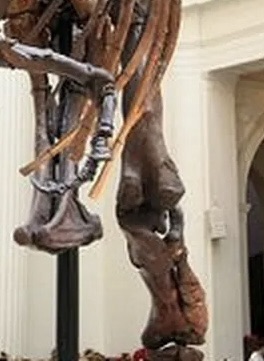
Sue allows us to get a glimpse of the life of Tyrannosaurus Rex, the king of the dinosaurs. An injury to the right shoulder region, likely from struggling prey, damaged the shoulder blade. It also tore a ligament in the right arm. Damage to ribs that healed shows that Sue survived this encounter. One of her most severe injuries is to the left fibula. The diameter is twice the size of her right fibula. This indicates that Sue suffered a bone infection from a serious injury. The injury was most likely from a horned or armored dinosaur.
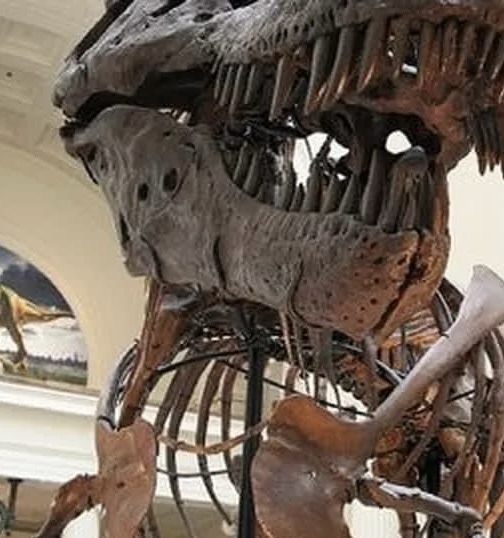
Holes on Sue’s lower jaw show parasitic infection.

The most fatal pathology seen in Sue’s skeleton is round holes in the lower jaw. The holes were from a trichomonas gallinae infection, a parasite that ate away at her bone. The infections cause swelling in the jaw and neck, resulting in death by starvation. It’s uncertain whether this was the fatal injury that ended Sue’s life. The agony from this pathology alone made it painful making ot hard for her to eat. Weighing 8 tons, Sue needed to consume an astounding number of calories to sustain her massive body. Unable to hunt or eat made it very difficult for her to survive. Tyrannosaurus Rex’s are social and hunt in groups. Given her advanced age at death, Sue was likely cared for by her social group.

Image Credit: Sue’s actual skull weighing 600 lbs. displayed at the Field Museum. Chicago, Illinois.

As she progressed in age, Sue suffered from arthritis showed by fused vertebrae in her tail. Some reports state that she had gout, but this is still debated.
Sue’s fossil shows that the life of a Tyrannosaurus Rex was difficult, painful, and complicated. The king of the dinosaurs did not have it easy. Hunting heavily armored prey was dangerous. Fighting other Tyrannosaurus over territory or mating rights was precarious. Injuries that became infected proved deadly. Sue forces us to rethink how dinosaurs relate to each other. The Cretaceous was dangerous even for a Tyrannosaurus Rex.

Death and Preservation of Sue’s Bones:

Profile of Sue Tyrannosaurus Rex (FMNH PR2081).

Sue died at 28 years of age. It is unknown how she died. But her skeleton poses likely scenarios. These include bone infections, starvation, or complications from parasitic disease. Preservation of her skeleton concludes that she died in a seasonal stream bed or flood. The flood washed away some of her bones. It jumbled the remaining skeletal parts together in a disarticulated manner. The sediment from the stream bed protected her body from scavengers preserving her skeleton quickly. This made her one of the most complete Tyrannosaurus Rex specimens ever discovered.

Image Credit: Sue standing proudly at her new home. Field Museum. Chicago, Illinois.

Sue is very important to paleontology and study of Tyrannosaurs Rex. Sue’s skeleton takes us back to a time when giants roamed the earth and allows us to see the life of T-rex. We can observe the injuries, diseases, and parasites that they encountered. Sue shows us that even the king of the dinosaurs had to scrape out life one day at a time. Life was challenging in the environment of the Cretaceous.

I write at the confluence of deep time and modern thought – a paleontology blogger and essayist devoted to translating ancient worlds for contemporary readers.

Through Coffee and Coelophysis, I explore the lives, mysteries, and afterlives of prehistoric dinosaurs, blending scientific curiosity with reflective story telling. I bring ancient fossils to life; across my other writing spaces, I explore literature, creative reflection, homesteading, backyard chicken keeping, and the lessons of observations.

In Shelf-Life: Lessons from Retail, the everyday world of retail becomes a stage where dinosaurs, books, and human stories collide – revealing how curiosity and wonder shape both past and present.

The Kuntry Klucker – A Blog About Keeping Backyard Chickens.

The Introvert Cafe – A Mental Health Blog

~ Noelle K. Moser ~
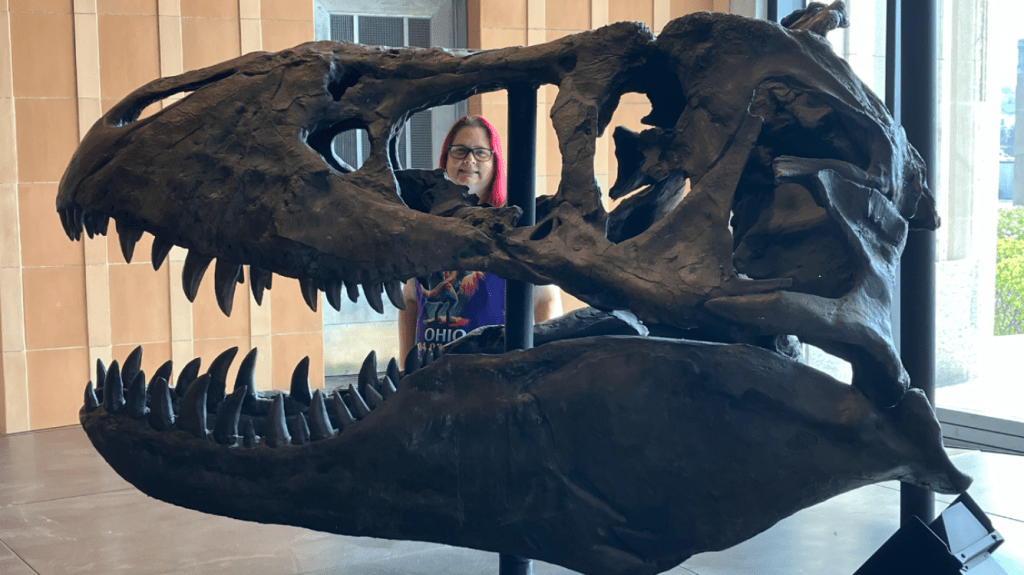
Me, peering through the fenestrae of Tyrannosaurus Rex specimen MOR 555. Cincinnati Museum Center. Cincinnati, Ohio.

Resources:

Larson, Peter. Tyrannosaurus Rex: The Tyrant King. Indiana University Press. Bloomington, Indiana. 2008.

Wikipedia Commons

My visit to The Field Museum. Chicago, Illinois.