Exploring the Houston Museum’s Dinosaur Treasures

Email: noellemoser@charter.net
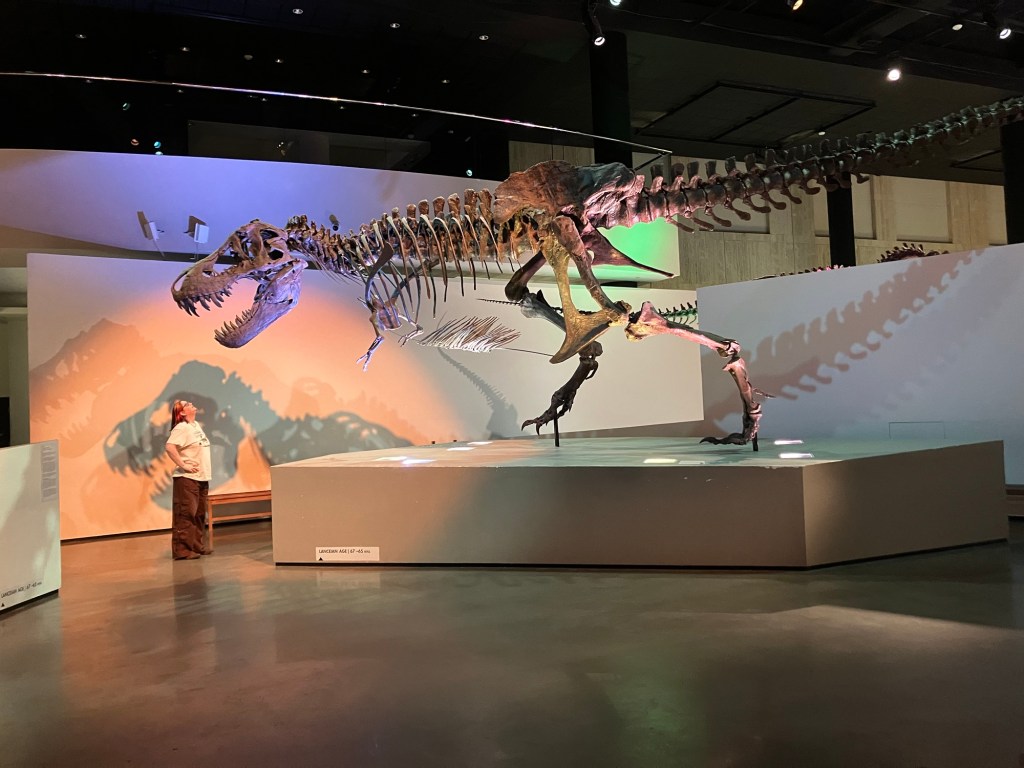
Image Credit: Noelle K. Moser. Stan and I, positioned at the intersection of popular culture and science. Like Stan, Tyrannosaurus Rex is a silent witness to a world we can only experience through bone. Houston Museum of Natural Science.

Disclaimer: This article reflects my independent observations and insights gained during my research at the Houston Museum of Natural Science. I want to clarify that I am not affiliated with the HMNS in any capacity and have not received any compensation for writing this piece. The views and opinions expressed are solely my own. I am a professional writer and researcher specializing in dinosaurs. I travel to museums across the country to gather information and insights for my blog, where I explore the fascinating world of theropods and Mesozoic life.

The study of the Mesozoic era presents intriguing opportunities for exploration, particularly through its remarkable dinosaurs that once roamed the Earth. After thorough planning, which involved securing airline tickets and hotel accommodations, I recently visited the esteemed Houston Museum of Natural Science in Houston, Texas. This destination is celebrated for its exceptional paleontology exhibits, notably featuring three impressive specimens of Tyrannosaurus rex. The museum serves as a valuable resource for anyone interested in the fascinating history of dinosaurs and their environments during the Mesozoic era.

Image Credit: Mary Haggard. Houston Museum of Natural Science.

During my visit, I was truly moved by the incredible fossil collection on display. Multiple specimens of Tyrannosaurus rex, Acrocanthosaurus, Allosaurus, and Gorgosaurus brought a sense of excitement and connection to the past. As I explored the exhibits of herbivores—Diplodocus, Triceratops, Hadrosaurs, Ankylosaurus, and even a rare pair of Quetzalcoatlus—I couldn’t help but feel a deep sense of wonder. It reminded me of the rich history these magnificent creatures represent and the awe they evoke, connecting us to a world we can only experience through bone.

As someone profoundly captivated by Tyrannosaurus Rex, I dedicate my work to exploring its evolution, adaptations, and the mysteries of its lifestyle, making this visit truly meaningful. Houston is home to specimens of Stan, Bucky, and Wyrex—famous T-rex individuals that each tell a unique story about the life and evolution of this apex predator. Studying these fossils up close allowed me to dive deeper into their adaptations, pathologies, and mysteries.

Beginning with The Morian Hall of Paleontology, visitors are offered an engaging exploration of prehistoric life through a diverse collection of fossils and visual displays. This innovative exhibition presents the concept of deep time in a way that accommodates various learning styles, making it an informative experience for a wide range of audiences.

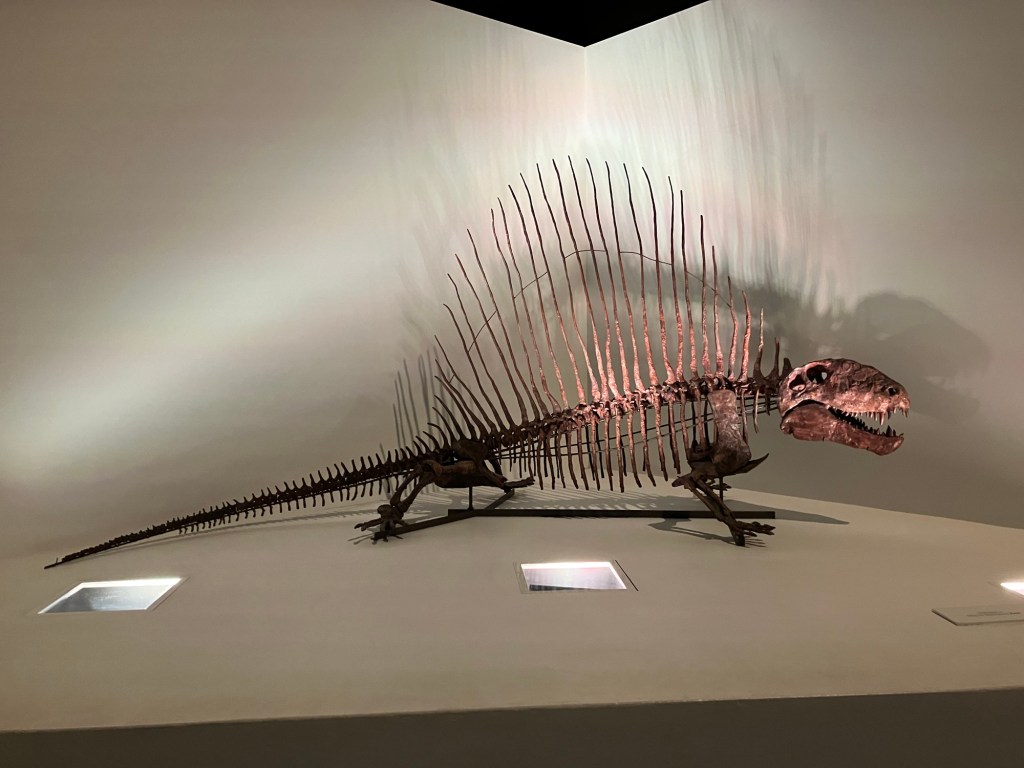
Immersed in a journey through deep time, visitors will encounter a variety of familiar prehistoric creatures. Notable among these are trilobites, which were marine arthropods, and ammonites, known for their coiled shells. The path also features early tetrapods, the four-legged ancestors of amphibians, reptiles, and mammals. Additionally, one might come across impressive Devonian giant fishes such as Dunkleosteus, as well as the Permian period’s Dimetrodon. Another significant creature to observe is the notable Triassic archosaur Postosuchus, an ancient reptilian predator.

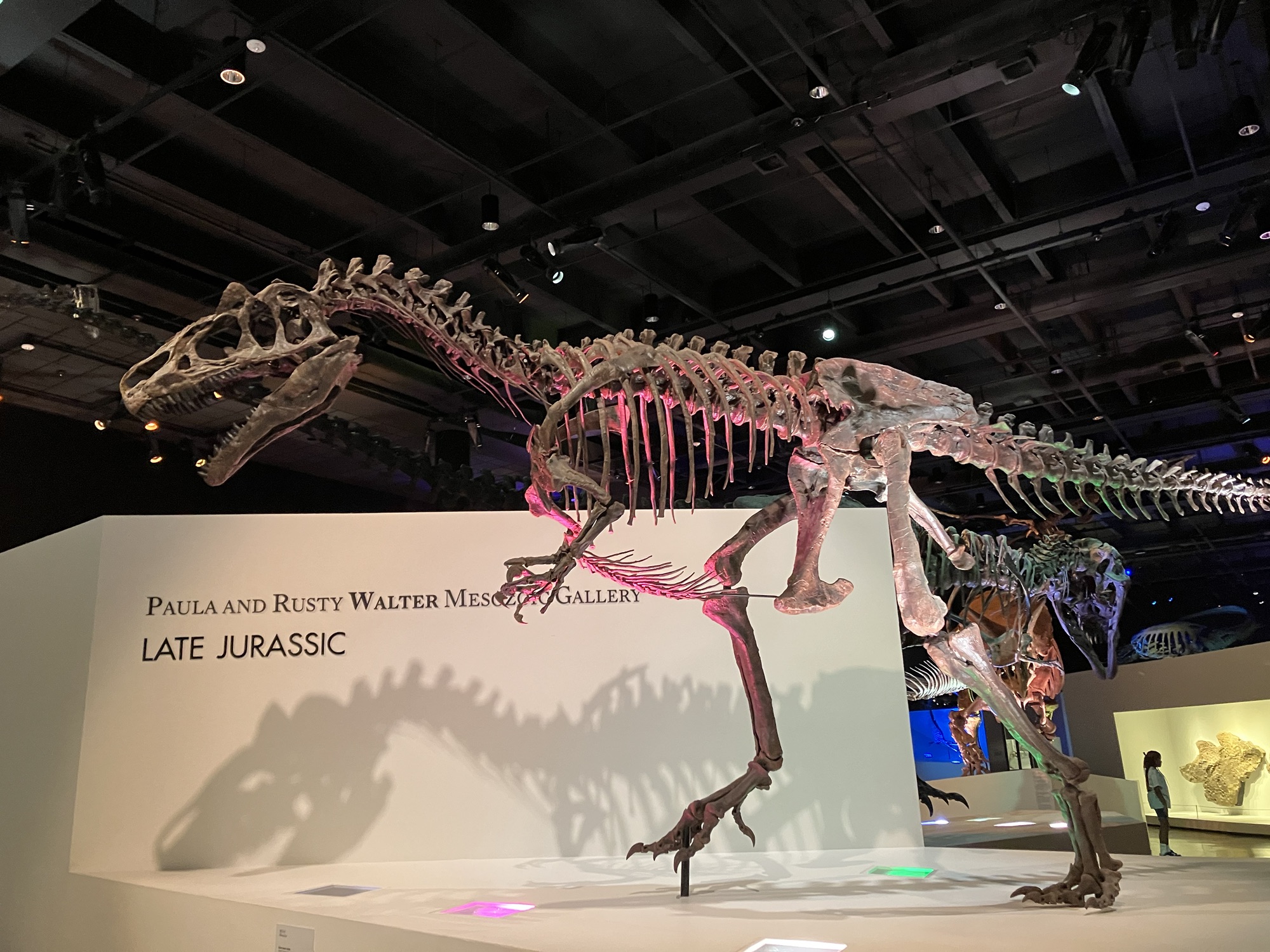
Entering the dinosaur hall, visitors are welcomed by the impressive cast of “Big Al,” the renowned Allosaurus that represents the pinnacle of Jurassic predators. Discovered in 1991 at the Howe Quarry in the Morrison Formation of Wyoming, “Big Al” is not only the most complete and well-preserved specimen of its kind but also a symbol of resilience. The pathologies revealed in this remarkable skeleton tell a powerful story of survival, showcasing evidence of injuries, diseases, broken bones, and the remarkable bone growths that came in response to adversity. “Big Al” inspires us to appreciate the strength and tenacity found in nature’s history.

Image Credit: Noelle K. Moser. Cast of “big Al”. Houston Museum of Natural Science

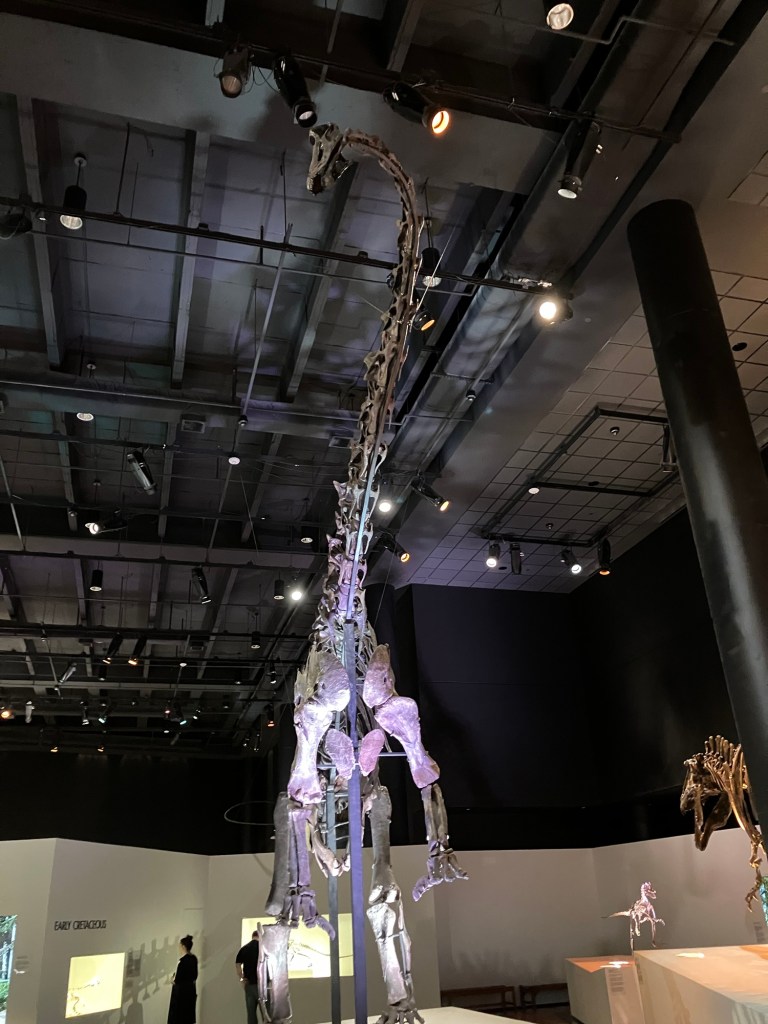
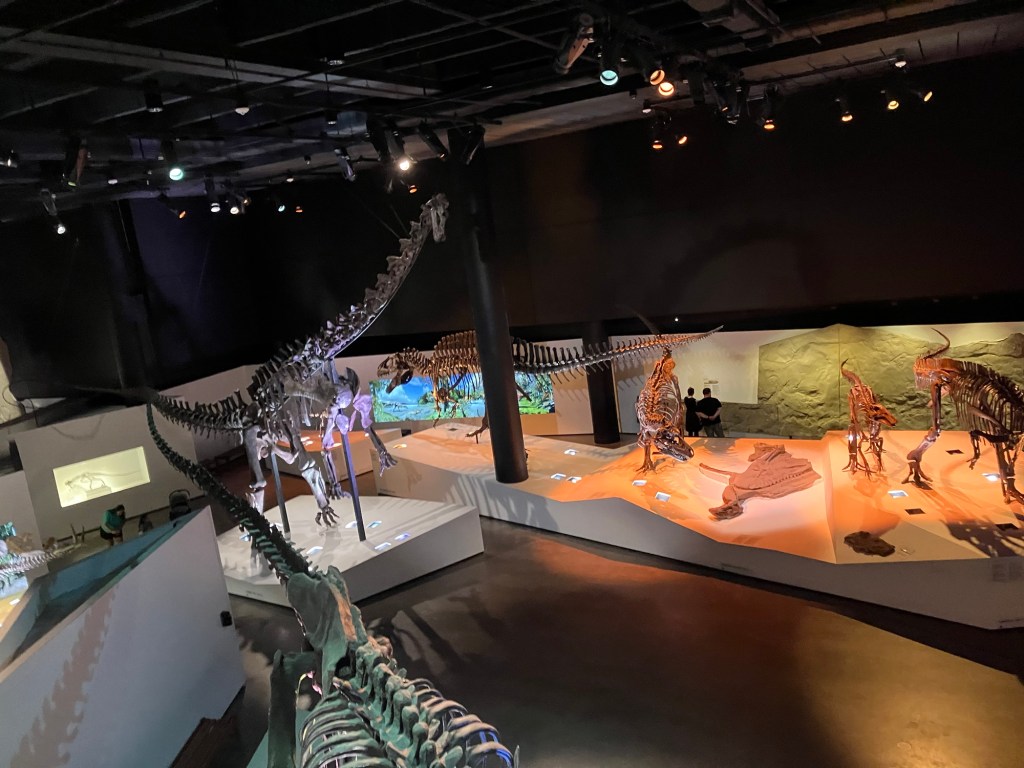
Stepping into the Paula and Rusty Walter Mesozoic Gallery, one is in awe of the vastness of space and the magnificent creatures that once roamed the Earth. Towering at the center is a Diplodocus rearing on its hind legs, long neck, and head stretching to the ceiling.

Image Credit: Noelle K. Moser. Diplodocus reared on its hind legs towering over theropods in various life-like poses. Houston Museum of Natural Science. Houston, Texas.

In various life-like poses stand a variety of large theropods and herbivores, each telling a story of the past. Most notable, and the reason for my venture to the Houston Museum of Natural Science, is BHI 3033, “Stan.”

Stan: The Tyrant Lizard King with Multiple Injuries

Image Credit: Mary Haggard. Stan and I, standing at the intersection of science and popular culture. Tyrannosaurus Rex is a silent witness to a world we can only experience through bone. Houston Museum of Natural Science. Houston, Texas.
Stan, a remarkable specimen found in 1987 in the Hell Creek Formation of Montana, serves as a beacon of discovery for paleontology and the biology of Tyrannosaurus rex. His fossil includes the most complete T. rex skull, a testament to the wonders of the natural world. Beyond the skull, Stan’s remains consist of 190 bones, representing about 63% of the entire skeleton, offering invaluable insights into the anatomy, lifestyle, and pathologies of one of the most intriguing Tyrannosaurus rex specimens in history. (Larson, 2008)
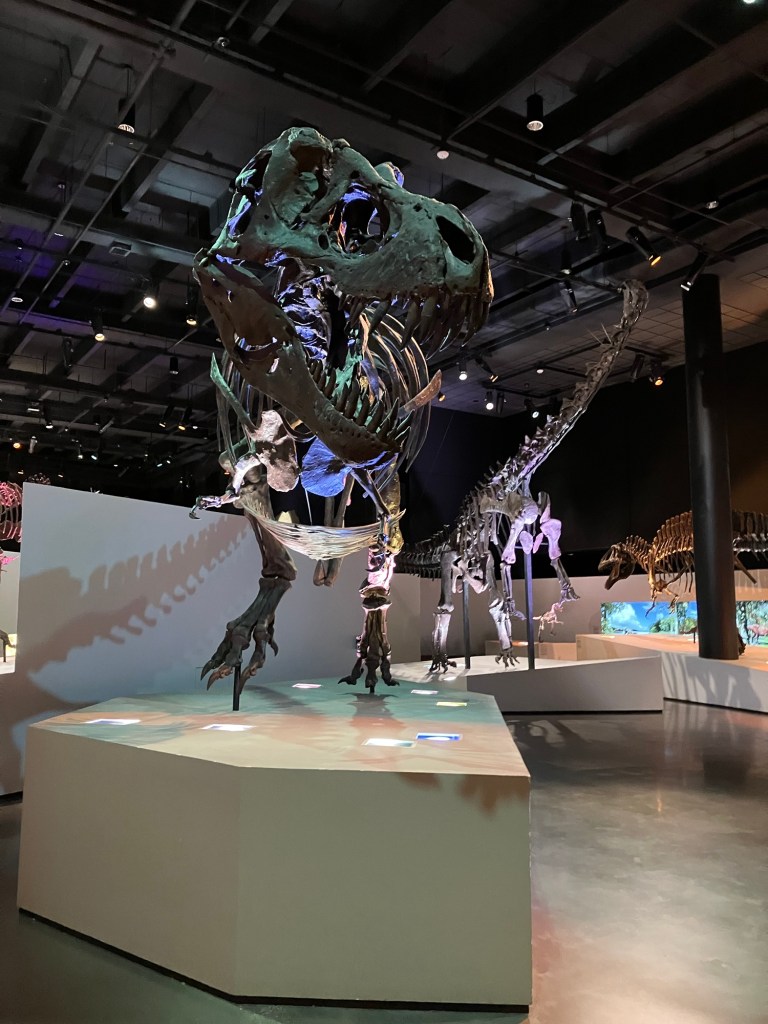
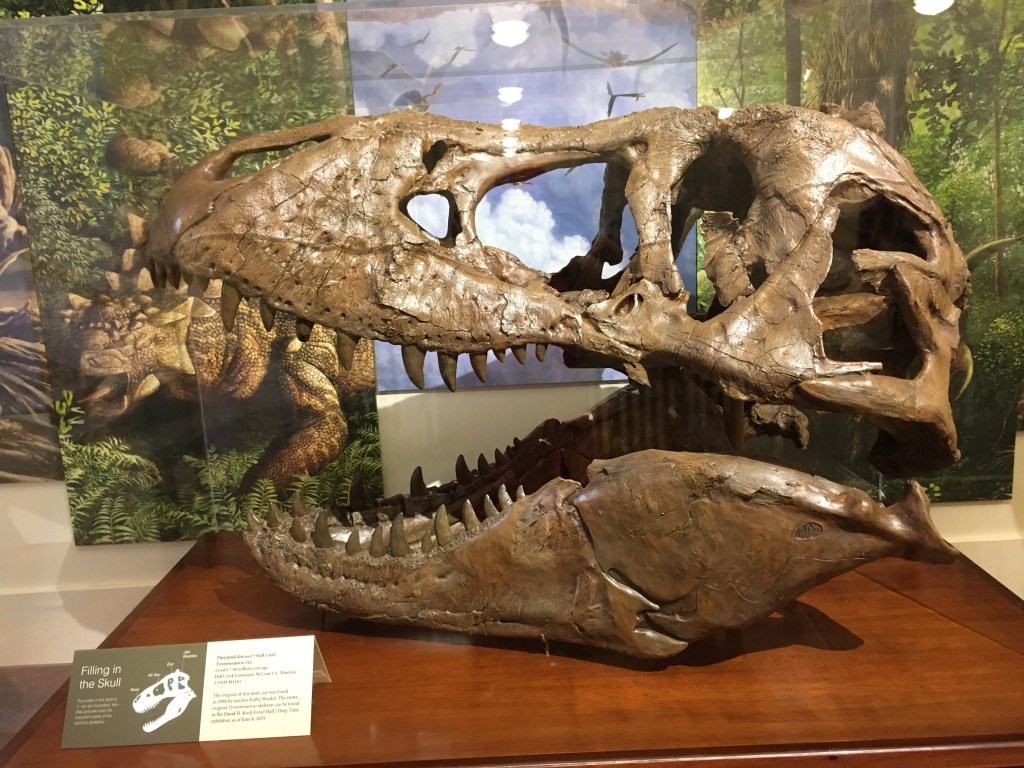
Image Credit: Noelle K. Moser. The impressive dental battery of Stan comprised of 60 conical serrated teeth. Houston Museum of Natural Science. Houston, Texas

An examination of Stan’s bones reveals multiple pathologies and healed injuries sustained throughout his life. Puncture wounds on the back of his skull and ribs suggest he was at one time bitten by another Tyrannosaurus Rex. Bite marks at the base of his skull indicate a significant neck injury, leading to the fusion of two vertebrae, likely causing him pain for the remainder of his life. Holes on the side of his skull suggest more healed wounds and possible infections from bone-eating parasites. Stan’s pathologies show that life in the Cretaceous was challenging, even for a Tyrannosaurus Rex.
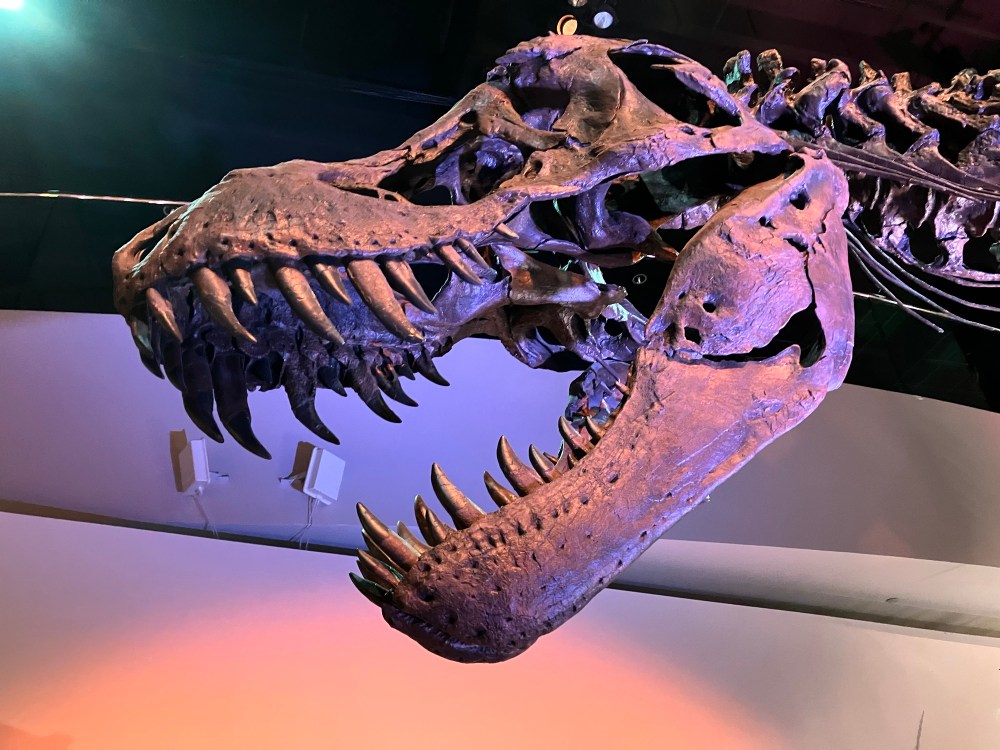
Image Credit: Noelle K. Moser. Holes on the side of Stan’s skull show pathology of healed injuries and possibly bone-eating parasitic infections. Houston Museum of Natural Science. Houston, Texas.

In a poised stalking stance with jaws gracefully agape, Stan proudly displays his formidable set of 60 teeth. Like all Tyrannosaurus rex specimens, he embodies extraordinary evolutionary development in dentation, demonstrating the power to overcome even the most daunting challenges in his quest for survival.
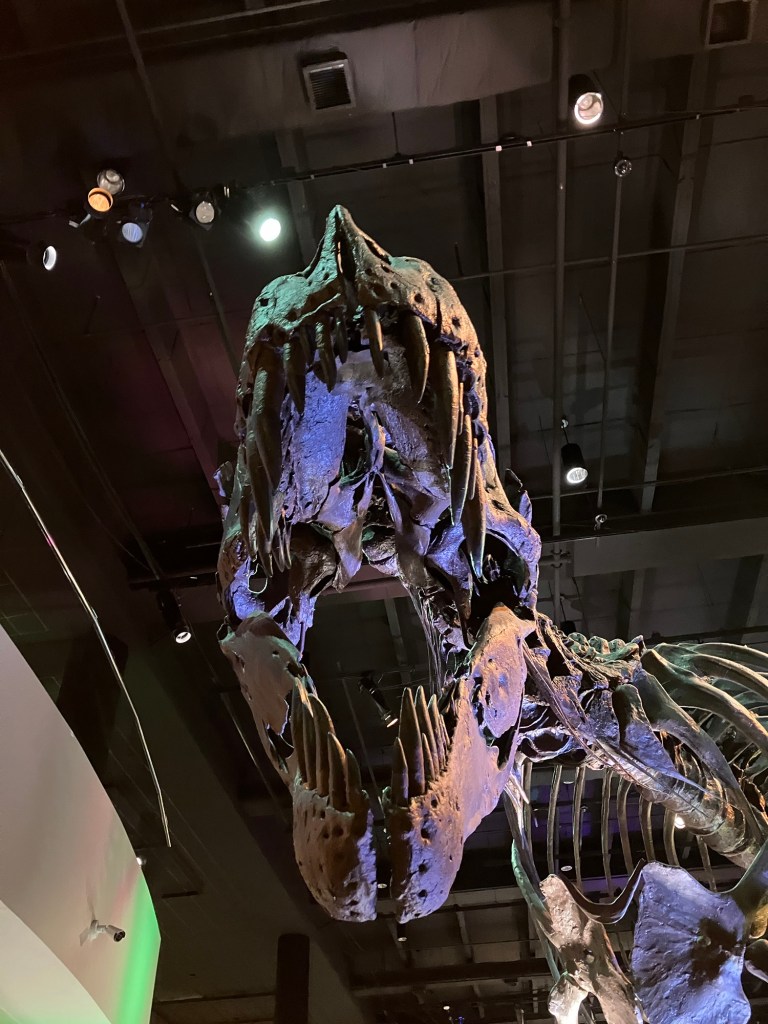
Image Credit: Noelle K. Moser. Stan proudly displays his formidable set of 60 teeth. Houston Museum of Natural Science. Houston, Texas.

Examining Stan in such an accessible manner has given me a deeper insight into his life through his skeletal remains. Despite suffering severe injuries and pain, Stan’s capacity for healing and survival is a testament to the extraordinary resilience and robustness of this theropod. While the bone analysis of Stan shows healing, another T-Rex was not as lucky.

Wyrex: The Bob-tailed T-Rex.

Image Credit: Noelle K. Moser. Wyrex, the bobtail T-rex. Houston Museum of Natural Science.

Discovered in 2002 within the Hell Creek Formation of Montana and transferred to the Houston Museum of Natural Science (HMNS) in 2009, the fossil known as “Wyrex” is an extraordinary Tyrannosaurus rex specimen. This groundbreaking discovery unveils a remarkable partial braincase and two nearly complete legs and feet, providing exhilarating new insights into the foot anatomy of the legendary Tyrannosaurus rex! (Larson, 2008)

Image Credit: Noelle K. Moser. Complete foot preserved with Wyrex providing exhilarating new insights into the foot anatomy of the legendary Tyrannosaurus rex. Houston Museum of Natural Science.

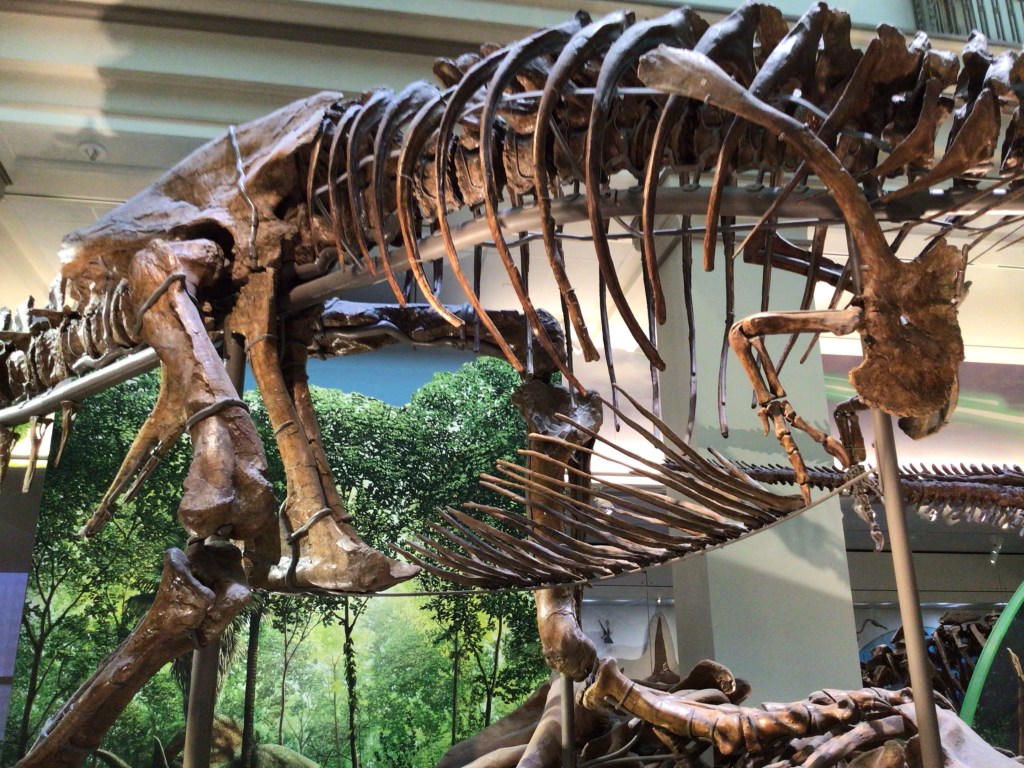
Mounted in an attack stance adjacent to an Ankylosaurus, it is readily apparent that one-third of the tail is absent. As a critical component of Tyrannosaurus rex anatomy, the tail serves as a counterbalance to the skull and accommodates powerful musculature necessary for locomotion.
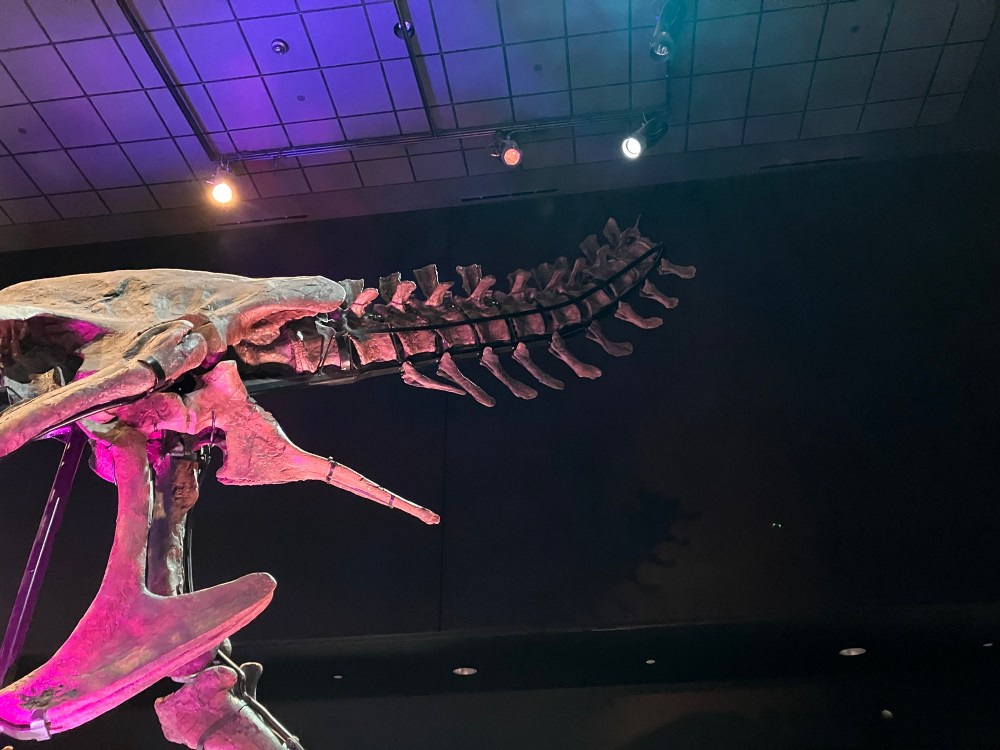
Image Credit: Noelle K. Moser. The tail serves as a counterbalance to the skull and accommodates powerful musculature necessary for locomotion. Houston Museum of Natural Science. Houston, Texas.

Analysis of the bone indicates no evidence of healing, suggesting that the tail may have been severed post-mortem, or that this injury ultimately unalived Wyrex. Had Wyrex survived this injury, the T-rex would have required a significant period of rehabilitation to regain the ability to walk effectively.

Image Credit: Noelle K. Moser. Wyrex, positioned in an imposing attack pose, offers visitors the opportunity to examine the remarkable dentition and distinctive anatomical characteristics of the formidable Tyrannosaurus Rex. Houston Museum of Natural Science.

Presented in an assertive attack stance, Wyrex offers visitors an exceptional opportunity for a detailed examination of its distinctive conical, serrated teeth. This close-up perspective not only showcases the impressive anatomy of this prehistoric predator but also fosters a deeper appreciation for the evolutionary traits that contributed to its role in the prehistoric ecosystem.

In addition to its other remarkable features, Wyrex has yielded another significant discovery: several patches of fossilized skin from the Tyrannosaurus rex. This finding marks the first time that such skin has been uncovered for this iconic dinosaur, providing new insights into its biology and appearance. (Larson, 2008).
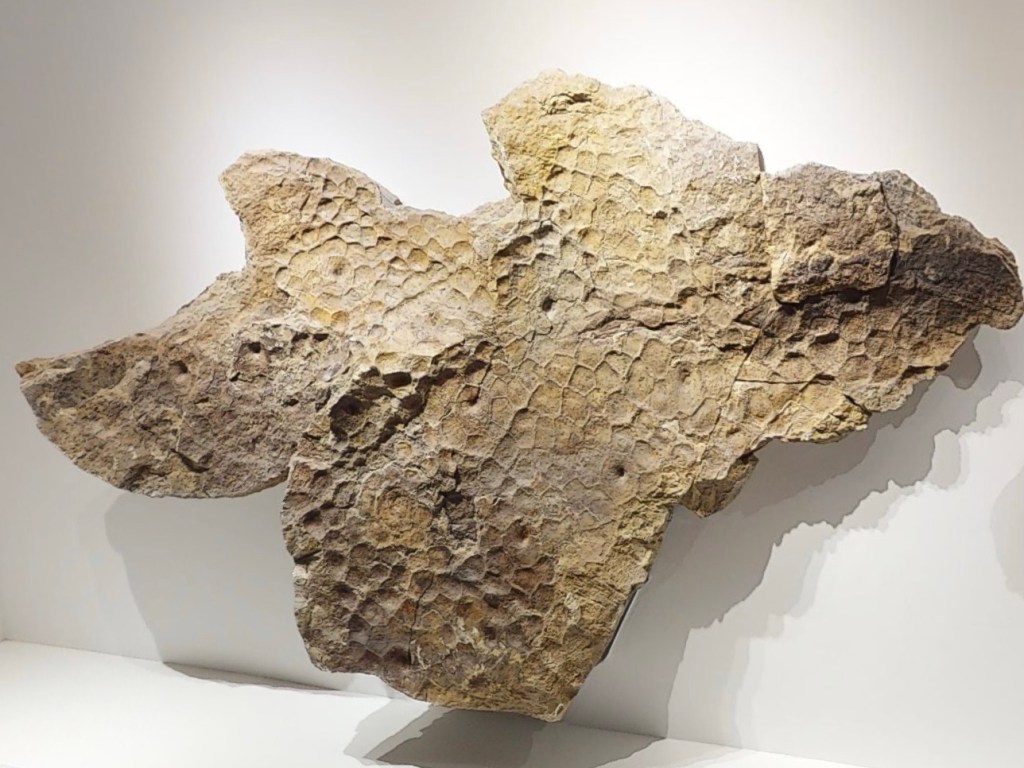
Patch of fossilized skin associated with Wyrex. Houston Museum of Natural Science. Houston, Texas

Bucky: A Female Teenage T-Rex.

Image Credit: Mary Haggard. Bucky plays a significant role in our understanding of Tyrannosaurus rex, as this remarkable fossil includes one of the most complete T-rex tails to date. Houston Museum of Natural Science. Houston, Texas.

The final Tyrannosaurus Rex showcased in the Paula and Rusty Walter Mesozoic Gallery is a sub-adult female TCM 2001.90.1 “Bucky”. Discovered in 2001 in the Hell Creek Formation by a rancher who, while breaking in a young horse, spotted the bones that led to this remarkable find, just 8 miles from where another robust female T-rex, Sue, was unearthed. (Larson, 2008)

Image Credit: Noelle K. Moser. Tyrannosaurus Rex Bucky and Wyrex present complementary highlights, drawing attention to the devastating tail injury that Wyrex sustained. Houston Museum of Natural Science. Houston, Texas.

Bucky plays a significant role in our understanding of Tyrannosaurus rex, as this remarkable fossil includes one of three most complete T-rex tails. It serves as a poignant reminder of the devastating injury that Wyrex endured, allowing us to reflect on the challenges a Tyrannosaurus rex faced in their lifetime.

As a sub-adult, juvenile teenage T. rex, Bucky provides valuable insights into the growth rates and different stages of maturity in the morphology of this iconic theropod. Bucky’s development illustrates the physical changes that occur as T. rexes progress from juveniles to adults, helping us understand their life cycle better.

Acrocanthrosaurus:
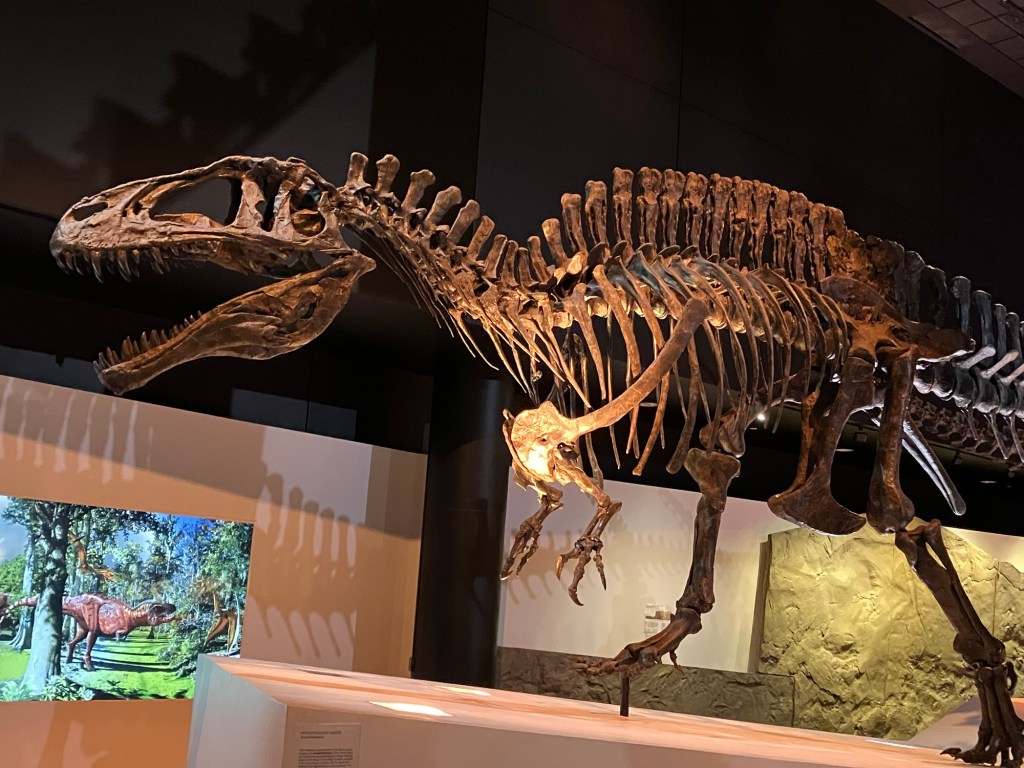
Image Credit: Noelle K. Moser. Acrocanthosaurus, the high-spined lizard of the Early Cretaceous. Houston Museum of Natural Science. Houston, Texas.

My journey to the Houston Museum of Natural Science would be incomplete without highlighting one last impressive theropod: Acrocanthosaurus. Most likely belonging to the Carcharodontosaur clade, a group of formidable predatory dinosaurs that thrived during the Aptian stage of the Early Cretaceous period.
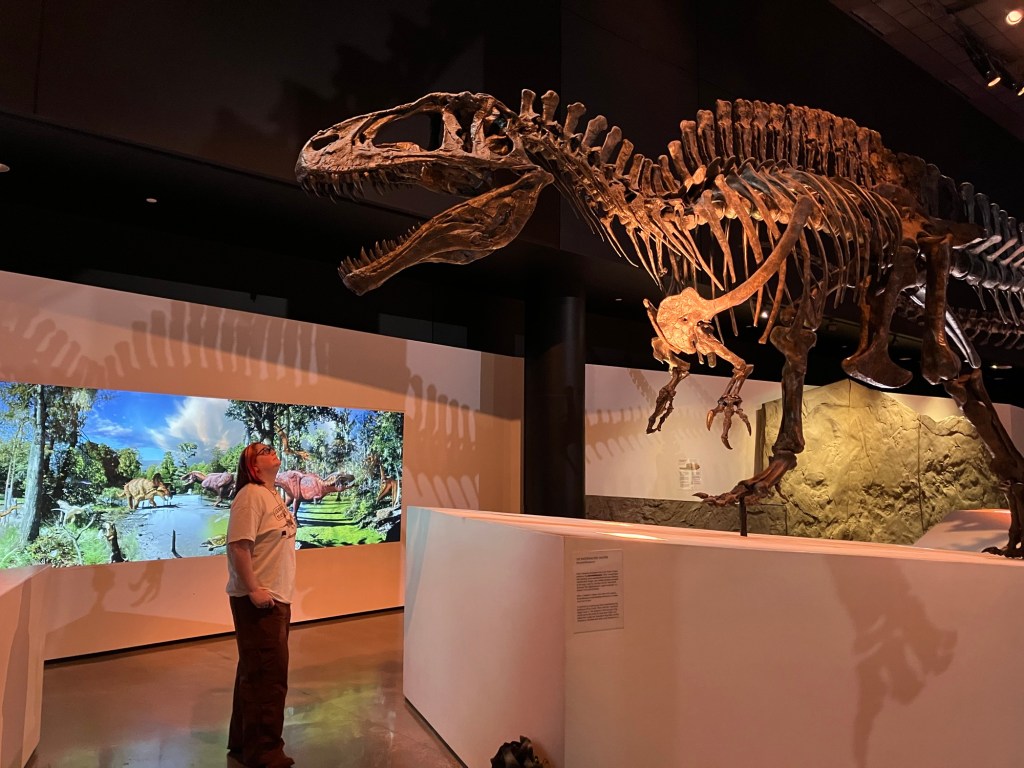
Image Credit: Mary Haggard. Acrocanthosaurus. Houston Museum of Natural Science. Houston, Texas.

Acrocanthosaurus stands out for its remarkably high neural spines, believed to have formed a striking sail along its back during its time on Earth. This formidable theropod once roamed ancient landscapes alongside colossal titanosaurs, majestic giants among the largest creatures ever to grace the Earth. Imagining these giant beasts sharing the same world ignites a sense of wonder and inspiration!

Image Credit: Noelle K. Moser. Stan viewed from the second-floor observation platform showcasing the immense size of this Cretaceous Apex Predator. Houston Museum of Natural Science.

Studying dinosaurs is not just a passion; it’s a profound calling to uncover the mysteries of their world and our planet. My research leads me to natural history museums across the nation, with each destination unveiling new insights into the fascinating realm of dinosaurs and deepening my admiration for these incredible creatures.

This visit highlighted the fascinating aspects of Tyrannosaurus Rex and reinforced the reasons behind their enduring appeal. It’s not merely their impressive size and strength; rather, the complex details of their existence contribute significantly to their allure. The experience provided an exceptional opportunity to observe a diverse array of theropod evolution and variety all in one location. Most importantly, the Houston Museum of Natural Science offers tangible access to the wonders of prehistoric Earth, connecting us to a lost world we can only experience through bone.
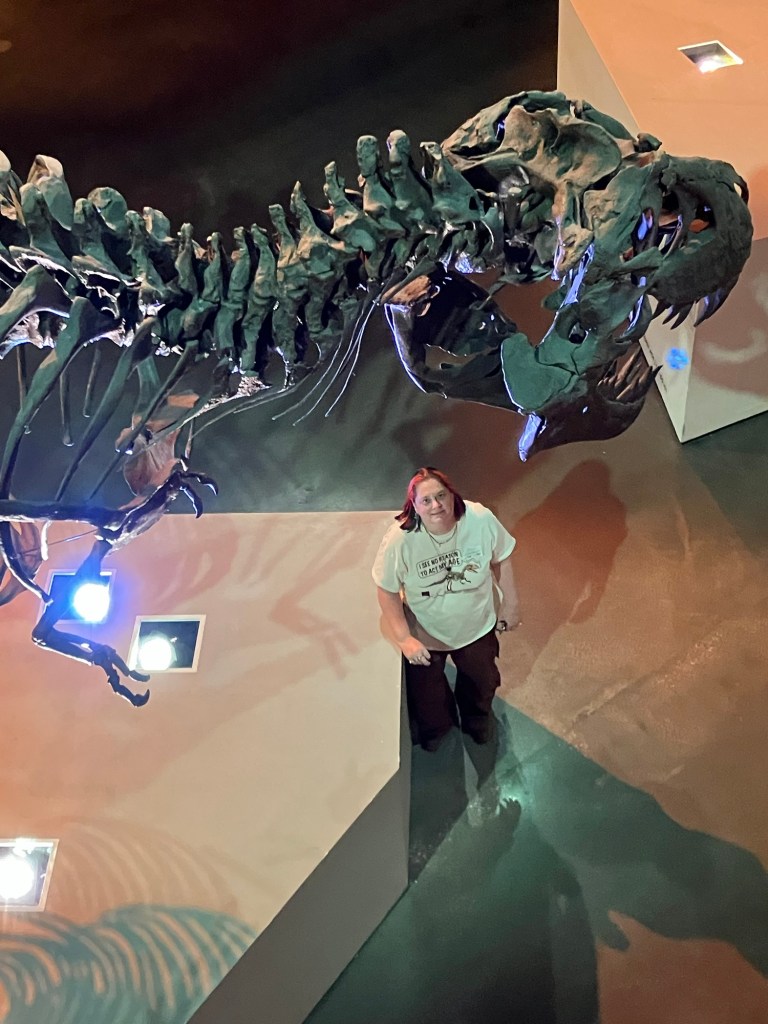
Image Credit: Mary Haggard. Studying dinosaurs connects us to a lost world we can only experience through bone. Houston Museum of Natural Science. Houston, Texas.

To watch a video of my trip to HMNS please visit my YouTube Channel.

I am a multi-disciplinary writer, paleontology blogger, and content creator. If you found this post engaging, be sure to check out my online writing portfolio to explore my extensive body of work.

Resources:

Larson, Peter and Carpenter, Kenneth. Tyrannosaurus Rex: The Tyrant King. Indiana University Press. Bloomington, Indiana. 2008.

Pim, Keiron. Dinosaurs the Grand Tour: Everything Worth Knowing About Dinosaurs from Aardonys to Zuniceratops. The Experiment. New York, NY. 2019.

My Visit to Houston Museum of Natural Science in Houston, Texas.

Allosaurus: Butcher of the Jurassic

Image Credit: Noelle K. Moser. Allosaurus: Houston Museum of Natural History

One-hundred and fifty million years ago, long before T-Rex reigned as the tyrant king of the dinosaurs, another fearsome theropod ruled the land his name, Allosaurus (AL-oh-SORE-us) Fragilis. Spanning a dynasty from 150 million to 144 million years ago during the late Jurassic period, Allosaurus is famous from the Cleveland-Lloyd Quarry in Utah, part of the Morrison Formation and one of the best-known ancient dinosaur graveyards in the world where the remains of 44 Allosaurus specimens lay entombed. Victims of a predator trap, the Allosaurus specimens from this Quarry are some of the actors in an epic prehistoric tragedy that unfolded 150 million years ago; this is the tale of that fateful day.

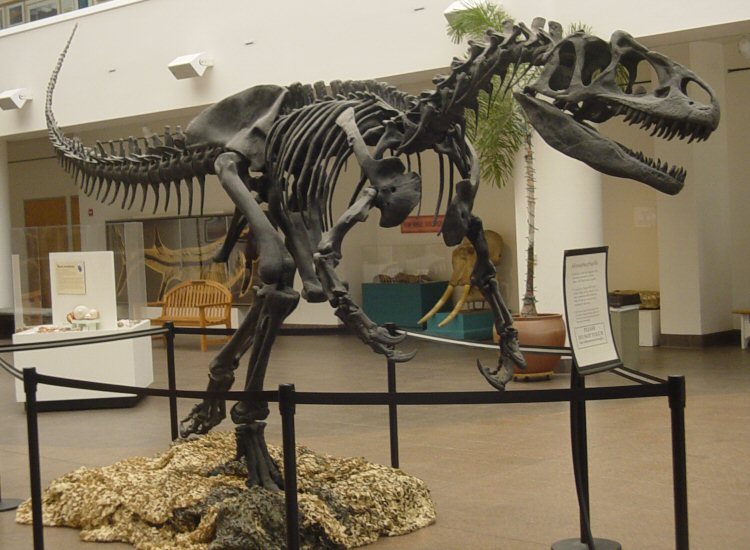
Image Credit: Allosaurus skeleton from the Cleveland-Lloyd Quarry.

Cleveland-Lloyd Quarry:

Before we can understand this epic tale and the part that Allosuaurs plays, we must look at the stage where this drama unfolds. The Cleveland-Lloyd Dinosaur Quarry well known for containing the densest concentration of Jurassic dinosaur fossils ever found, is a paleontological site located near Cleveland, Utah in the San Rafael Swell, a part of the geological layers known as the Morrison Formation.

Morrison Formation:

Image Credit: Morrison Formation in Utah

The Morrison Formation is a distinctive sequence of Upper Jurassic sedimentary rock found in the western United States, which has been the most fertile source of dinosaur fossils in North America and covers an area of 600,000 square miles. Composed of mudstone, sandstone, siltstone, and limestone with a light gray, greenish, and red sediment, the Morrison Formation was a Jurassic waterway shortly after Lauraisa split into the continents of North America and Eurasia.

Image Credit: Map of the continents 150 million years ago during the Jurassic Period.

As North America moved north and passed through the subtropical regions, the deposits from drainage basins carried by streams and rivers became the Morrison Formation. Above is a map of the Earth as the contents traversed the globe due to plate tectonics.

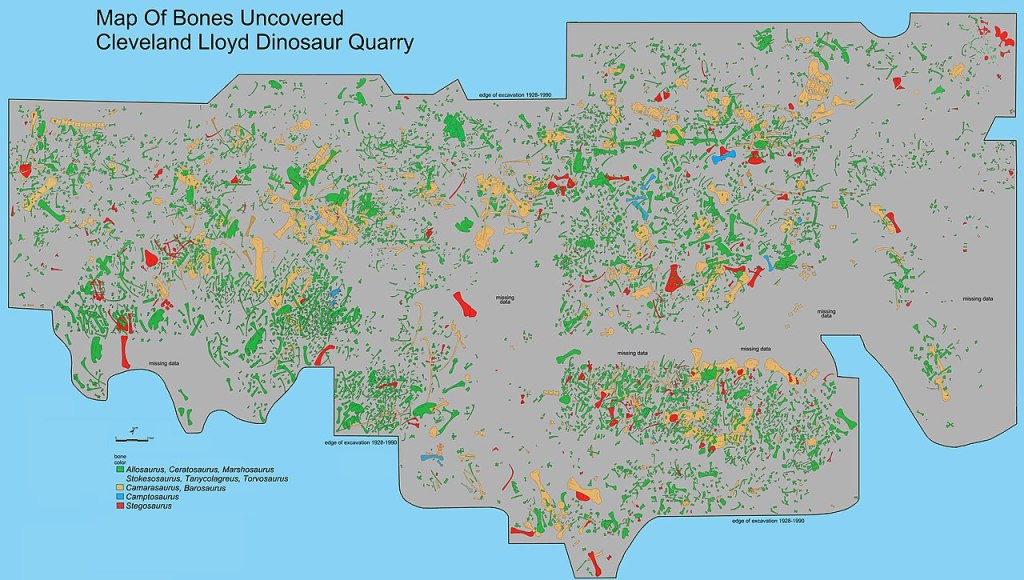
Image Credit: Cleveland-Lloyd Quarry map of Jurassic Dinosaurs bones.

Above is a map of all the dinosaur bones found preserved within the Cleveland-Lloyd Quarry. Looking at this grapic two things are abundantly clear.

First, the amount of carnivores present at the Cleveland-Lloyd Quarry is staggering. Indicated in green, the theropods present are predominately Allosaurus. Accompanying Allosaurus are the remains of Ceratosaurus (SERR-at-oh-SORE-us) – the most dragon like-dinosaur known and relative of Abelisaurus, Stokesaurus – the first tyrannosauroids and primitive ancestor of Tyrannosaurus Rex, Mashosaurus (MARSH-o-SORE-us), Torvosaurus (TORE-voh-SORE-us) the biggest carnivore of its time – as big as Allosaurs and heavier too, and Tanycolagreus – a primitive coelurosaurian theropod.

Second, the herbivores present are fewer but noteworthy. In yellow are the remains of several massive sauropods, Camarasaurus (CAM-a-ra-SORE-us) – 25.4 tons and Brontosaurus Excelsus (BRONT-oh-SORE-us) – 18 tons. Denoted in blue are the remains of an Ornithopod Camptosaurus (CAMP-toe-SORE-us), and indicated in red are the remains of several Thyreophora or armored dinosaurs known as Stegosaurus.

Image Credit: A Barosaurus defending itself against a pair of Allosaurus Thereopods.

Upon looking at the remains encompassing a wide variety of different dinosaurs, it is clear that something unusual attracted the assemblage of paleofauna to this location. Carnivores outnumbering herbivores points to scenes in which predators flocked to the site. What drew the diverse number of theropods to this site 150 million years ago? This Jurassic crime scene preserved in stone – the Cleveland-LLoyd Quarry – is a predator trap.

What is a Predator Trap? How Does it work?

predator trap results from a natural hazard where prey animals become trapped or incapacitated, and the predators attracted to the struggling prey suffer the same fate. As more and more animals become ensnared in the trap, additional predators and scavenges become attracted to this mounting accumulation of carrion until a wide variety of animals are tragically caught and killed by the natural hazard. The predator trap can appear many times, accumulating countless victims over millions of years.

Unlike the dry landscape today, 150 million years ago, the Cleveland-Lloyd Quarry was a freshwater lake, a source of water that drew many dinosaurs to its shores. Much like Africa today, this area had wet and dry seasons. The wet seasons, with torrential rains and floods, would fill the landscape with water. As the dry season approached, the water would dry up; dense mud would then take the place of the water. It is this weather cycle that sets the stage for what happens next.

How did the Cleveland-Lloyd Quarry Drama Unfold?

While it’s impossible to say exactly how the events unfolded at the Cleveland-Lloyd Quarry 150 million year ago, fossil evidence suggests a probable interpretation of that fateful day. Brad Cypy. (2014, July 13) Jurassic Fight Club: Bloodies Battle {Video File}. YouTube

Cleveland-Lloyd Quarry. 9:00 am – Act 1; Scene 1. Adult Stegosaurus and Offspring Enters, Stage Right.

Image Credit: Stegosaurus

A Stegosaurus and her young searching for water approach the shrinking lake bed. The hardened upper crust buckles under their massive weight, causing their feet to sink into the soft muck below and become affixed. The cries of distress from the Stegosaurus pair attract a lone carnivore, Ceratosaurus (SERR-at-oh-SORE-us).

Cleveland-Lloyd Quarry. 9:30 am. – Act 1; Scene 2. Ceratosaurus Enters Stage Left.

Image Credit: Ceratosaurus

The fossil record shows that a lone Ceratosaurus was the first to arrive at the scene at Cleveland-Lloyd Quarry. One of the rarest killers, Ceratosaurus, is 13 feet tall, 20 feet from snout to tail, and weighs 3,000 pounds, a mid-size predator in the Late Jurassic. Ceratosaurus may not have been massive, but his oversized teeth that worked like a meat slicer made him a fearsome beast. (Pim, 2019)

Ceratosaurus underneath a Stegosaurus. National Museum of Natural History. Washington, D.C.

Ceratosaurus has the most wicked teeth of any predator that walked the Earth because he has two different kinds of teeth, a trait rare in theropods. The upper teeth were long and blade-like, and the lower teeth were conical and more powerful. Ceratosaurs would use the lower jaws to grab ahold of flesh and bring down the top teeth like a meat slicer cutting a chunk out of his prey. Ceratosaurus’s bite allowed him to compensate for two weaknesses: diminished forearm claws and smaller leg muscles, reducing speed and agility. Not equipped for battle, Ceratosaurus is made to slash and dash. Dinosaurs: The Complete, Up-To-Date Encyclopedia. (Holtz & Rey. 2007).

Observing the Stegosaur pair trapped in the mire, Ceratosaurus attacks the smaller Stegosaurus. Taking massive chunks out of the struggling Stegosaurus pair.

Cleveland-Lloyd Quarry. 10:00 am. – Act 1; Scene 3. A small group of Allosaurus Approach the Lakebed. Center Stage.

The most common dinosaur found at the Cleveland-Lloyd Quarry site is Allsoaurus. Allosaurus predates Tyrannosaurus Rex by 80 million years and is the first giant theropod to roam North America.

Image Credit: Allosaurus Attacking Stegosaurus Pair.

The name Allosaurus means “Other Reptile”. At its time, there was nothing as fearsome as Allosaurus. The first of the giant meat-eating dinosaurs, this carnivore was Tyrannosaurus Rex before there was Tyrannosaurus Rex. Possessing a rare trait in theropods, Allosaurus had “Freddie Krueger” like hands with three fingers armed with a long, sharp sickle claw used to slash and tear flesh. 13 feet tall, 40 feet from snout to tail, and weighing up to 8,000 pounds (4 tons), Allosaurus is the butcher of the Jurassic. (Pim, 2019).

Allosaurus, equipped to take on big game hunted sauropods, some of the largest animals the planet has ever seen during the Late Jurassic. A long, rigid tail provided excellent balance. Coupled with massive leg muscles, Allosaurus is a powerful, fast runner with incredible agility. Dinosaurs: The Most Complete Up-To-Date Encyclopedia (Holtz & Rey, 2007).

Image Credit: Endocast of Allosaurus Brain

Endocasts of the Allosaurus brain reveal that in addition to being the first giant theropod, Allosaurus was also the smartest carnivore in the Late Jurassic. Allosaurus was capable of advanced social behaviors such as cooperative hunting and planning. Like modern-day birds, Allosaurus was very social and lived in small groups.

A roaming group of Allosaurus arrive at the dried lake bed, attracted by the sound of disruption and the smell of fresh blood. The Allosaurus see the Stegosaurus pair stuck in the thick mire and a single Ceratosaurus. The fossil record shows that a single Ceratosaurus was present at the Cleveland-Lloyd Quarry, its bones crushed by another dinosaur.

Cleveland-Lloyd Quarry. 10:30 am – Act 1; Scene 4. The Allosaurus Kill the Ceratosaurus and feed on the Stegosaurus Pair.

Attempting to defend its meal against the Allosaurus group, the Ceratosaurus has an altercation with the Allosaurus. Small and not robust like the much more derived Allosaurus, the Ceratosaurus is out-competed, crushed, and killed by better-equipped theropods.

Splade toes allow the theropods to walk on top of the hardened crust of the dried lake bed without sinking into the muck below. Circling the herbivores, the Allosaurus group continues to feed on the larger struggling Stegosaurus. Armed with plates along its back and spikes at the end of its tail, the Stegosaurus uses all its defenses to the best of its ability. The fossil records show that one of the Allosaurus has pathologies indicative of a Stegosaur strike by the spikes on its tail. The other Allosaurus, underestimating the Stegosaurus’s ability, takes a step back when another group of dinosaurs enters the scene.

Splayed toes of theropods allow them to distribute their weight over larger areas.

Cleveland-Lloyd Quarry. 11:00 am. – Act 2; Scene 1. Camarasaurus Herd Enter, Stage Left.

Image Credit: Camarasaurus Herd

Traversing the Jurassic landscape on yearly migrations, a traveling herd of Camarasaurus severely parched arrived at the water source. Due to the ongoing drought resulting from the dry season, the much-needed water had transitioned to a thick, soupy mud. Motivated by desperate thirst, the Camarasaurus herd approached the moist, thick muck.

Witnessing the unfolding bloody scene, driven by intense thirst, the leading Camasasaurus cautiously approaches the dried lake bed. Victim of his weight, the Camasaurus breaks through the hardened top layer and becomes entrapped by its weight, and the 25-ton Camarasaurus’s feet sink deep into the silt. Unable to free its feet, the Camarasaurus cried in distress. The Allosaurus, determining that attacking the Stegosaurus is too risky, sees the Camarasaurus as an easier target and approaches the struggling titan.

Unable to free its feet, the Camarasaurus cried in distress. Another group of nearby Allosaurus heard the cries of anguish and approached the scene. Upon observing the entrapped Sauropod, the carnivores assumed a free meal was at hand, hot-footed toward the struggling prey.

Cleveland-Lloyd Quarry. 11:30 am. – Act 2; Scene 2. The Noise, Smell of Blood, and Carnage Attract More Predators.

Adding to the chorus of distressing calls of anguish, the entrapped herbivores, and battling carnivores attract more predators to the scene.

The fossil record of this event shows that under the feet of the Camarasaurus lies the crushed body of an Allosaurus. At some point during the struggle, the Camarasaurus freed its front legs and reared up on its hind legs, crushing an Allosaurus running towards it.

More carnivores arrive, attracted by the carnage as the battle rages. Allosaurus, the most common animal at this site, fought and killed each other as they competed for the carcasses. As more carnivores became trapped in the thick mire, the predator trap claimed more victims. The noise at Cleveland-Lloyd Quarry on this day 150 million years ago would have been deafening. It is evident from the events recorded in stone that the land flowed with blood.

~ End Scene ~

Image Credit: Carnivores Fighting Over Carrion at Clevenland-Lloyd Quarry.

This Jurassic crime scene is a resource for dinosaur bones and allows us to understand how these animals relate to each other. The largest dinosaur graveyard, Cleveland-Lloyd Quarry, is still revealing its secrets.

I am a multi-disciplinary writer, blogger, and web content creator. Please visit my writing portfolio and other blogs if you like this post.

The Works Of Noelle K. Moser – Writing Portfolio

The Kuntry Klucker – A blog about keeping backyard chickens.

Chicken Math University – A blog about homeschooling

~ Noelle K. Moser ~

Allosaurus and I. National Museum of Natural History in Washington, D.C.

Resources:

Holtz, Thomas. R. Jr. & Rey, Luis V. Dinosaurs. The Most Complete, Up-To-Date Encyclopedia. New York, Random House, 2007.

Pim, Keiron & Pastori, Fabio. Dinosaurs The Grand Tour. New York, The Experiment, 2019.

Ransom-Johnson, Evan & Csotonyi, Julius. Dinosaur World. Kennebunkport, Maine, Applesauce Press, 2023

Theropod Evolution: Unveiling Meraxes Gigas, the Late Cretaceous Giant

Image Credit: Meraxes Gigas.

We have a new dinosaur! A theropod with short limbs like Tyrannosaurus Rex. Tyrannosaurus is not the only famous giant carnivorous dinosaur; meet Meraxes Gigas.

During the summer of 2022, researchers uncovered a previously unknown dinosaur from the Late Cretaceous, Meraxes Gigas. Meraxes belongs to the genus carcharodontosaurid theropods. The name, “Meraxes”, honors a dragon from the George R. R. Martin novel, A Song of Ice and Fire – Wikipedia The specific name, “Gigas”, derived from the Greek word meaning “giant”, in reference to the theropod’s large size.

Found in the Huincul Formation of Argentine Patagonia was a nearly complete skeleton. Meraxes Gigas is of pivotal importance because this discovery constitute a complete skull, partial forelimbs, complete hindlimbs, fragmentary ribs, and cervical and complete caudal vertebrae. 

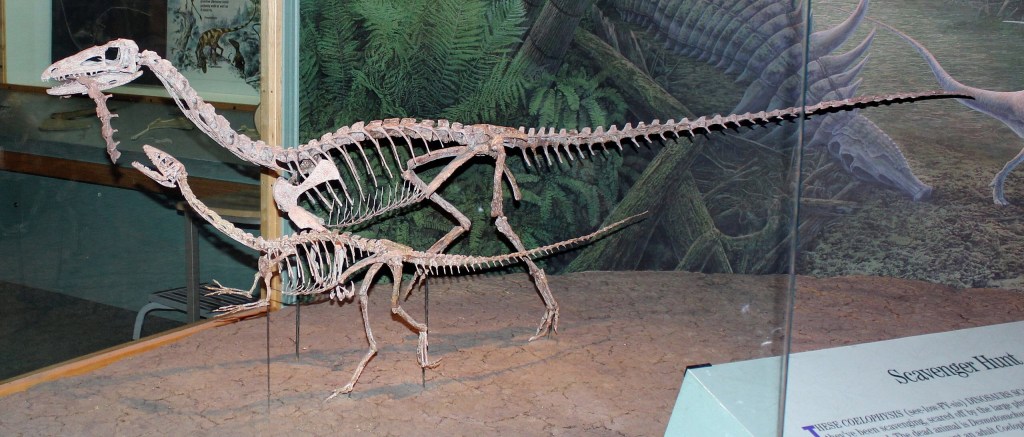
The hand of theropods is imperative to determine whether the specimen is primitive or derived. Primitive in dinosaur terminology means an early stage in evolutionary development. Derived means most recent in dinosaurian evolution. To help this make sense, Coelophysis is a primitive ancestor of the derived Tyrannosaurus Rex.

Image Credit: Gignotosaurus skeleton, notice the longer arms and three digits on each hand. Giganotosaurus is more derived than the primitive theropod Coelophysis.

Primitive theropod dinosaurs have longer arms and digital formula I-IV. Derived theropods will have shorter arms and a reduced number of digits.

Image Credit: Coelophysis primitive theropod dinosaur. Notice that Ceolophysis has longer arms and 4 digits on each hand.

Coelophysis, the oldest known theropod, defined as a primitive Late Triassic theropod had longer arms and 4 digits on each hand.

Image Credit: Allosaurus

Allosaurus, more derived lived during the Middle-Late Jurassic and possess shorter arms and only three digits on each hand. Tyrannosaurus the Cretaceous apex predator had very short arms and only 2 digits on each hand.

Image Credit: Noelle K. Moser. Walter, Tyrannosaurus Rex located in Washington, D.C. has very short arms and only 2 digits on each hand.

As observed by these images, the skull, forearms, hands, and digits are gold in theropod discoveries. The hands of theropod dinosaurs tell us so much about the evolution of dinosaurs during the Mesozoic.

In addition to the forearms and digits, complete or near complete skulls found in new dinosaurs’ discoveries help us understand more about the creatures.

At first glance, the skulls of these giant theropods appear similar; massive jaws with numerous long serrated teeth. To the trained eye, the skulls of Giganotosaurus and Tyrannosaurus Rex are remarkably different.

Giganotosaurus has a long narrow skull that comes to a sharp point. The skull of Tyrannosaurus Rex is boxier and comes to a lateral line rather than a point. See the images below.

Another example of primitive and derived evolution is theropods, Allosaurus, Ceratosaurus, and, Tyrannosaurus. See the images below.

While these three theropods appear similar, Allosaurus and contemporary Ceratosaurus predate Tyrannosaurus by 80 million years.

Head Creasts:

Another feature present in theropod dinosaurs, specifically primitive species, is that of head crests. Many Late Triassic and Early Jurassic theropod species possessed head crests. It is thought that these crests were used as display features for mating and sexual dimorphism. In later derived theropod species, these crests disappear.

Image Credit:

The image above depicts Ceratosaurus nasicornis, the apex predator of the early Jurassic, displaying crests on the head can be seen. Ceratosaurus was driven to extinction by the Late Jurassic, succeeded by the more successful Allosaurus.

Image Credit:

Allosaurus, as mentioned above, is the most famous predecessor to Tyrannosaurus Rex. Living through the greater part of the Jurassic, Allosaurus was the apex predator of its time and possessed primitive features – three-digit hands, long forearms, and head crests. It is now known why derived theropods lose the head crests.

Image Credit:

By the time we traverse, the expansive amount of time between Ceratosaurus and Tyrannosaurus Rex (80 million years) head crests disappear from theropod anatomy.

Size:

In addition to reduced digits and head crests, as theropods evolve they get larger. Coelophysis at maturity was about 10 feet long and weighed 100 pounds. Compare that to the Jurassic theropod Ceraosaurus which grew to 20 feet long and weighed about 2,000 pounds. Allosaurus grew to be 12 feet long and 10 feet tall weighing 2.3 metric tons. Tyrannosaurus Rex, the largest land theropod to ever live grew to 43 feet long and weighed 6-8 tons.

Meraxes Gigas:

Now, that you have a better understanding of theropod dinosaurs, let’s take another look at Meraxes gigas. Meraxes is a crucial find in the world of dinosaur studies because the remains included key anatomical features, a complete forelimb, hand, a skull, and various other bones. The most important being that of the hand and skull.

According to the research, Meraxes Gigas had tiny arms like Tyrannosaurus with three digits on each hand like Allosaurus. Tyrannosaurus and Meraxies are not related as they are separated by about 20 million years, but it does suggest that as theropods evolved larger heads, the arms shrunk, no longer useful for hunting. Regarding size, Meraxes Gigas was 36 feet long and weighed 4 tons. To put this into perspective, Meraxies is smaller than Tyrannosaurus Rex but much larger than Allosaurus. Further noted, Meraxies does not appear to have head crests.

In terms of theropod evolution, Meraxies is more derived than Allosaurus but primitive compared to Tyrannosaurus. In terms of theropod evolution, this put Meraxies Gigas living about 90 to 100 million years ago, firmly in the Late Cretaceous. Meraxes Gigas and its close relative, Giganotosaurus died out in the Late Cretaceous, succeeding their position at the top of the food chain to the tyrannosaurids, and its famous member, Tyrannosaurus Rex.

Meraxes Gigas and the newly discovered theropod dinosaur were one of the last groups of giant carnivores to walk the Earth. While we often think of Tyrannosaurus Rex as being the lone giant carnivore stalking the Cretaceous, other large theropods competed with the tyrant dinosaurs. Although Meraxes Gigas never laid witness to the meteor that would ultimately bring the reign of the dinosaurs to an end, Tyrannosaurus Rex did.

I am a multi-disciplinary writer, blogger, and web content creator. If you liked this post, chomp the subscribe button.

If you like this blog, please visit my portfolio. Writer | The Works Of Noelle Moser

As always, thanks for reading Coffee and Coelophysis. Next time, we will take an in-depth look at the most famous theropod, Tyrannosaurus Rex.

~ Noelle ~